
Generative Engine Optimization (GEO): Capturing B2B Demand in 2026

 By Admin
 October 30, 2026
A B2B buyer no longer starts with ten blue links. They ask an AI assistant to name the best vendors, compare them, and explain the trade-offs. If your brand is missing from that answer, you are missing from the shortlist.
Generative Engine Optimization (GEO) is the strategic discipline of optimizing digital content and brand authority to ensure prominent citations, recommendations, and placement within AI-powered answer engines like ChatGPT, Perplexity, Claude, and Google AI Overviews.
The shift is already measurable. G2's March 2026 survey of 1,076 software buyers found that 51% now start research with an AI chatbot more often than with Google, and 69% said a chatbot led them to choose a different vendor than they had planned.
This guide explains how AI-led buyer discovery works, how GEO differs from SEO, and how to build and measure a B2B AI search optimization program that earns citations.
What Is GEO and Why Traditional SEO Is Falling Short in 2026
GEO builds on SEO's fundamentals but optimizes for a different outcome. SEO earns a ranking and a click. GEO earns a citation inside the answer itself.
The 2026 Search Reality
AI answers now sit above the organic results. BrightEdge tracked AI Overviews on about 48% of tracked queries in February 2026, up from roughly 31% a year earlier. The average overview is about 1,200 pixels tall, enough to push the first organic result below the fold.
Attention shifts, and clicks follow. Pew Research Center found that users clicked a traditional result in 8% of visits with an AI summary, versus 15% without one (March 2025 browsing data).
Rankings no longer predict citations either. Only about 17% of sources cited in AI Overviews also rank in the organic top 10. In B2B tech, 28.1% of cited sources rank nowhere in the top 100, according to the same BrightEdge analysis.
Keep perspective, though. Octane11's analysis of 400 million B2B sessions shows AI engines still send under 2% of B2B search traffic, despite 35x growth since March 2025. The traffic is small; the influence is not, because roughly one in 11 closed-won deals carries an AI search touch.
Inclusion also carries weight: G2 found that 85% of buyers think more highly of a vendor when AI includes it in an answer.
What this means for B2B marketing leaders:
Page-one rankings no longer guarantee a place in the answer.
Your passages compete with analysts, review sites, and communities, not just rival vendors.
Clicks undercount influence, so measurement has to go beyond sessions.
Buyers Are Delegating Vendor Selection to AI Agents
Buyers want fewer sales conversations. Gartner's 2026 survey of 646 B2B buyers found that 67% prefer a rep-free experience and 45% used AI during a recent purchase.
Automation goes further. Gartner predicts that by 2028, 90% of B2B buying will be AI-agent intermediated, moving more than $15 trillion of spend through agent exchanges.
Forrester's State of Business Buying, 2026 points the same way. GenAI searches are now the starting point, and buyers then lean on colleagues and outside experts to justify and de-risk the decision.
When buyers rely on automated agents to streamline vendor selection, your content is read by machines first. The same shift behind agentic AI workflows transforming enterprise efficiency in 2026 is now reaching procurement.
GEO vs. SEO Framework Matrix
GEO vs SEO 2026: the disciplines overlap, but the unit of success changes. Google confirms that a page must be indexed and snippet-eligible to appear as a supporting link in AI Overviews, so SEO remains your entry ticket.
Goal: Traditional SEO aims to rank and earn the click. GEO aims to be cited, recommended, and described accurately.
Unit of optimization: SEO works at the page and keyword level. GEO works at the passage, entity, and claim level.
Retrieval logic: SEO relies on keywords, links, and relevance signals. GEO relies on semantic retrieval, query fan-out, and re-ranking.
Winning signals: SEO rewards backlinks, relevance, and technical health. GEO rewards entity clarity, statistics, quotations, and third-party corroboration.
Content format: SEO favors long-form pages targeting terms. GEO favors answer-first, self-contained passages.
Primary KPI: SEO tracks rankings, clicks, and organic sessions. GEO tracks citation rate, share of model, and assisted pipeline.
Main risk: SEO faces algorithm updates. GEO faces misattribution, hallucination, and non-deterministic answers.
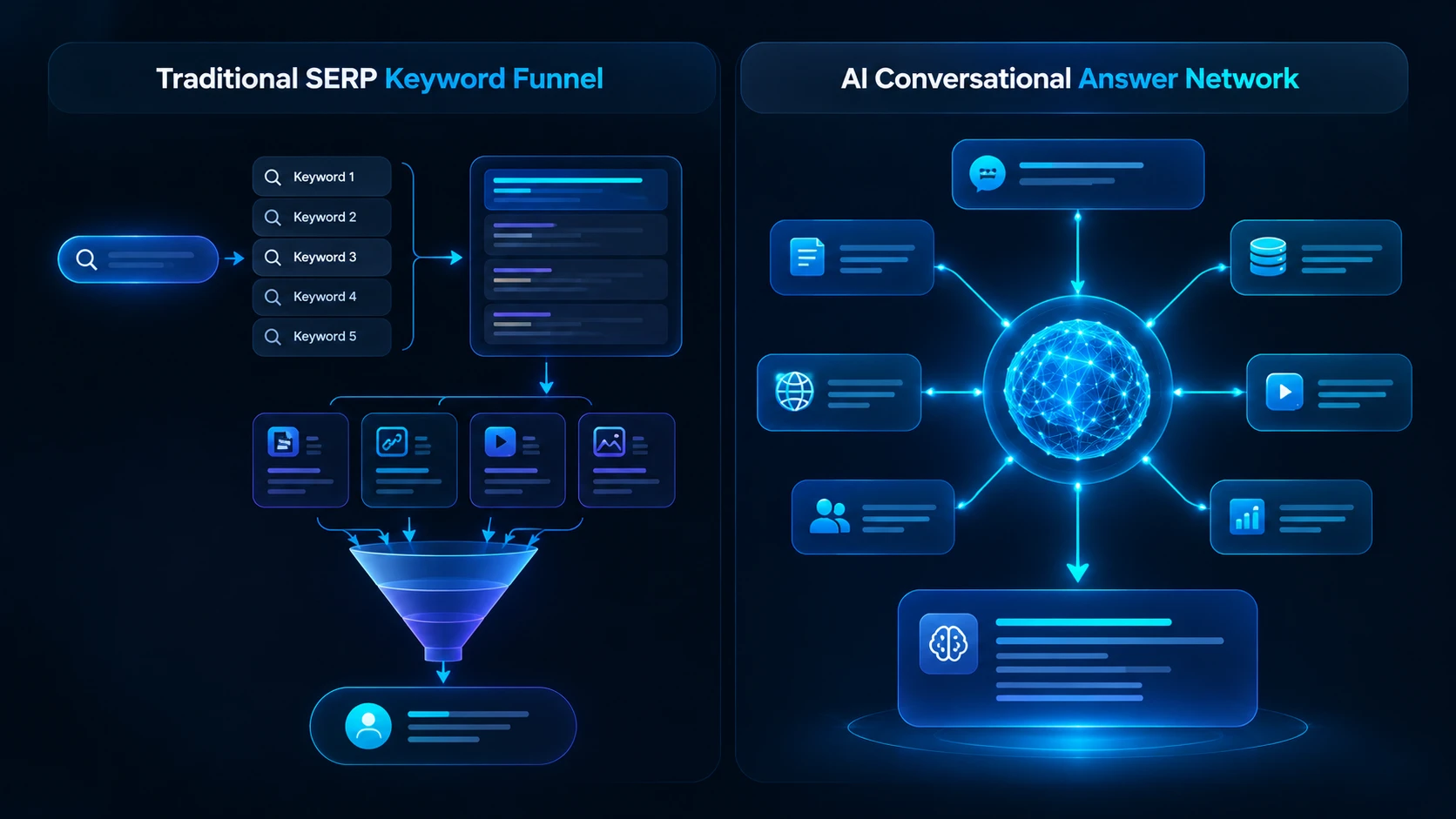
One finding from the original KDD 2024 GEO study by Princeton and IIT Delhi researchers matters here. Keyword stuffing, a legacy SEO tactic, delivered little to no visibility gain in generative responses.
The Mechanics of AI Discovery: How LLMs and RAG Select B2B Sources
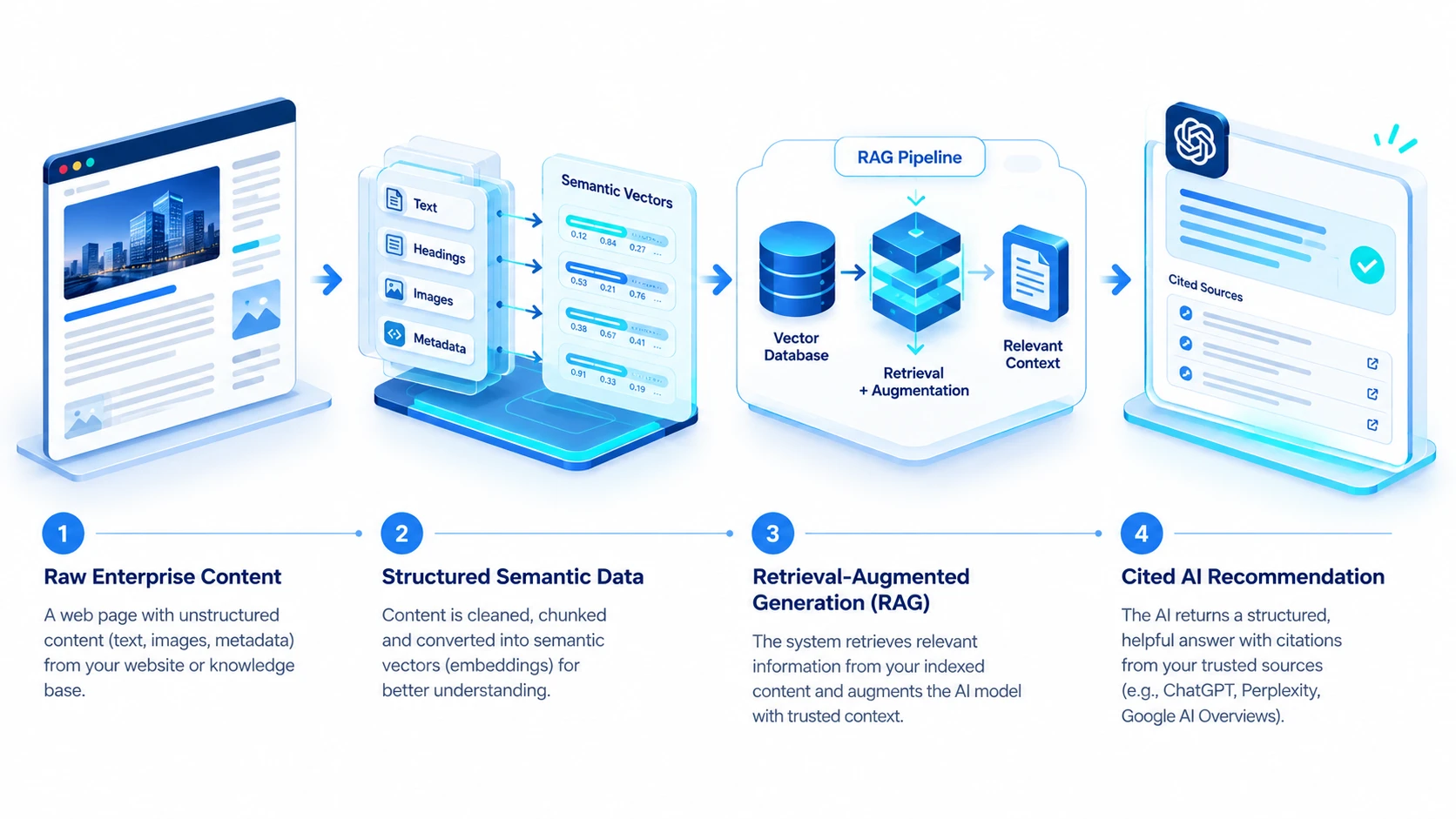
Most answer engines rely on Retrieval-Augmented Generation (RAG). They retrieve passages from an index, then ask a large language model to write an answer grounded in them. Your goal is to be retrieved, trusted, and quoted.
The RAG Pipeline in Five Steps
In a typical pipeline, the process runs like this:
Query understanding and fan-out. The engine rewrites the prompt and splits it into sub-queries. Google says AI Overviews and AI Mode may use a “query fan-out” technique that issues multiple related searches across subtopics.
Retrieval. Content is chunked, converted into semantic entity embeddings, and stored in a vector database. The engine pulls the passages closest in meaning to each sub-query, often blended with keyword and link signals.
Re-ranking. A ranking model scores candidate passages for relevance, authority, and freshness.
Grounded generation. The LLM drafts the answer using the selected passages as context.
Citation. The engine attributes claims to a small set of sources. Those citations are your visibility.
What Makes a B2B Source Citable
Citation is a selection problem. Six signals separate cited sources from ignored ones:
Entity clarity. Consistent names, definitions, and relationships help models disambiguate your brand, products, and people, and connect them to a knowledge graph.
Passage-level answers. Retrieval works on chunks, not pages. Each section should open with a direct answer and make one claim.
Statistical density and quotations. In the Princeton study, adding citations, quotations, and statistics lifted visibility by 30% to 40% on its primary metric, and by up to 40% overall.
Third-party corroboration. In G2's survey, review-site citations were buyers' top trust signal in AI recommendations.
Decision-support page types. Adobe's 2026 analysis found that solutions pages and buying guides score highest among B2B tech discovery pages on its AI citation readability measure (85%).
Eligibility and freshness. Pages must be indexed and snippet-eligible for Google's AI features. Keep dates, versions, and pricing current.
Together, these signals build your semantic footprint: the entities, topics, and claims engines associate with your brand. Topical authority across a full cluster makes it likelier that one of your passages answers a given sub-query.
Engines also differ from one another. Google's AI features draw on Google's index, while ChatGPT search relies on a crawler OpenAI documents separately, so treat each platform as its own channel and audit it on its own.
Step-by-Step Implementation Framework for B2B GEO
Build your LLM citation strategy in six steps. Run them in order, because each one depends on the last.
Baseline your AI visibility. Build a panel of 50 to 100 buyer prompts covering category, comparison, pricing, integration, and security questions. Run them across ChatGPT, Perplexity, Gemini, Claude, and Google AI Overviews, and log who is cited, mentioned, and described accurately. Perplexity numbers its citations, which makes it a convenient place to start.
Map the fan-out. For each core topic, list the sub-questions an engine would ask: alternatives, implementation effort, compliance, total cost, and integrations. Cover each one, so a sub-query retrieves your page.
Rewrite for passage-level retrieval. Lead each section with a standalone answer in the first two sentences, name entities consistently, and replace vague claims with numbers. Gartner's sales guidance likewise advises structuring content into modular, agent-ready building blocks.
Add evidence density. Insert original statistics, expert quotations, and inline citations to primary sources. The Princeton study also found that fluency and readability edits lifted visibility by 15% to 30%, and that pairing fluency with statistics beat any single tactic.
Strengthen entity and structured-data signals. Implement Organization, Product, Article, FAQPage, and Person schema, with
sameAslinks to your LinkedIn, Crunchbase, and Wikidata profiles. Google says AI Overviews need no special optimization, so treat schema as disambiguation, not a ranking lever.Earn corroboration off-site. Secure analyst coverage, customer reviews, partner pages, and expert contributions that repeat your key claims. Independent sources give engines more places to retrieve your claims from, and give buyers a reason to trust them.
Seed your prompt panel with real buyer language:
“Best enterprise workflow automation platforms for regulated industries”
“Vendor A vs Vendor B: which fits a 1,000-seat rollout better?”
“How long does it take to implement an enterprise workflow platform?”
“What does enterprise workflow software cost for 1,000 users?”
“Is Vendor A SOC 2 compliant, and which integrations does it support?”
Illustrative Scenario: Documentation Rebuilt for AI Retrieval
This is a hypothetical composite, not a client result. A US-based enterprise B2B SaaS platform ranks on page one for its category terms, yet appears in only 20% of 80 tracked buyer prompts. Its technical documentation is scattered across PDFs, gated whitepapers, and long product pages.
Over 90 days, the team restructures that documentation into entity-dense semantic clusters. Each use case, integration, and security topic gets one canonical page with a direct answer, a statistics table, and a sourced expert quote. It also adds Organization and Product schema, publishes a dated facts page, updates its review-site profiles, and re-tests each rewritten cluster every 30 days.
The illustrative outcome: citation presence across Perplexity and ChatGPT rises 115%, from 20% to 43% of tracked prompts. For context, the Princeton study recorded a 115.1% visibility gain for fifth-ranked sources that added citations, while the top-ranked source lost 30.3%.
Governance: Privacy, Brand Safety, and Hallucination Control
Structure brand data for machines, but govern it for people.
Separate training from retrieval. OpenAI documents GPTBot and OAI-SearchBot as independent robots.txt controls: one covers model training, the other ChatGPT search. Sites opted out of OAI-SearchBot will not appear in ChatGPT search answers.
Publish a canonical facts page. Dated, versioned pricing, certifications, integrations, and leadership names give models one authoritative source and reduce hallucinated specifics.
Monitor and correct. Audit AI answers monthly for wrong claims, fix the source content first, then use each platform's feedback channels for persistent errors.
Protect sensitive data. Keep customer data, internal pricing logic, and roadmaps out of crawlable pages, and publish personal data in case studies or bios only with consent under GDPR, UK GDPR, and US state privacy laws. Use Google's preview controls deliberately to limit how content appears in AI features.
Measuring GEO ROI and AI Citation Velocity
Classic dashboards undercount AI influence. Measure whether buyers see you, trust you, and arrive pre-qualified, not just whether they click.
Tracking AI Citation Velocity and Share of Model
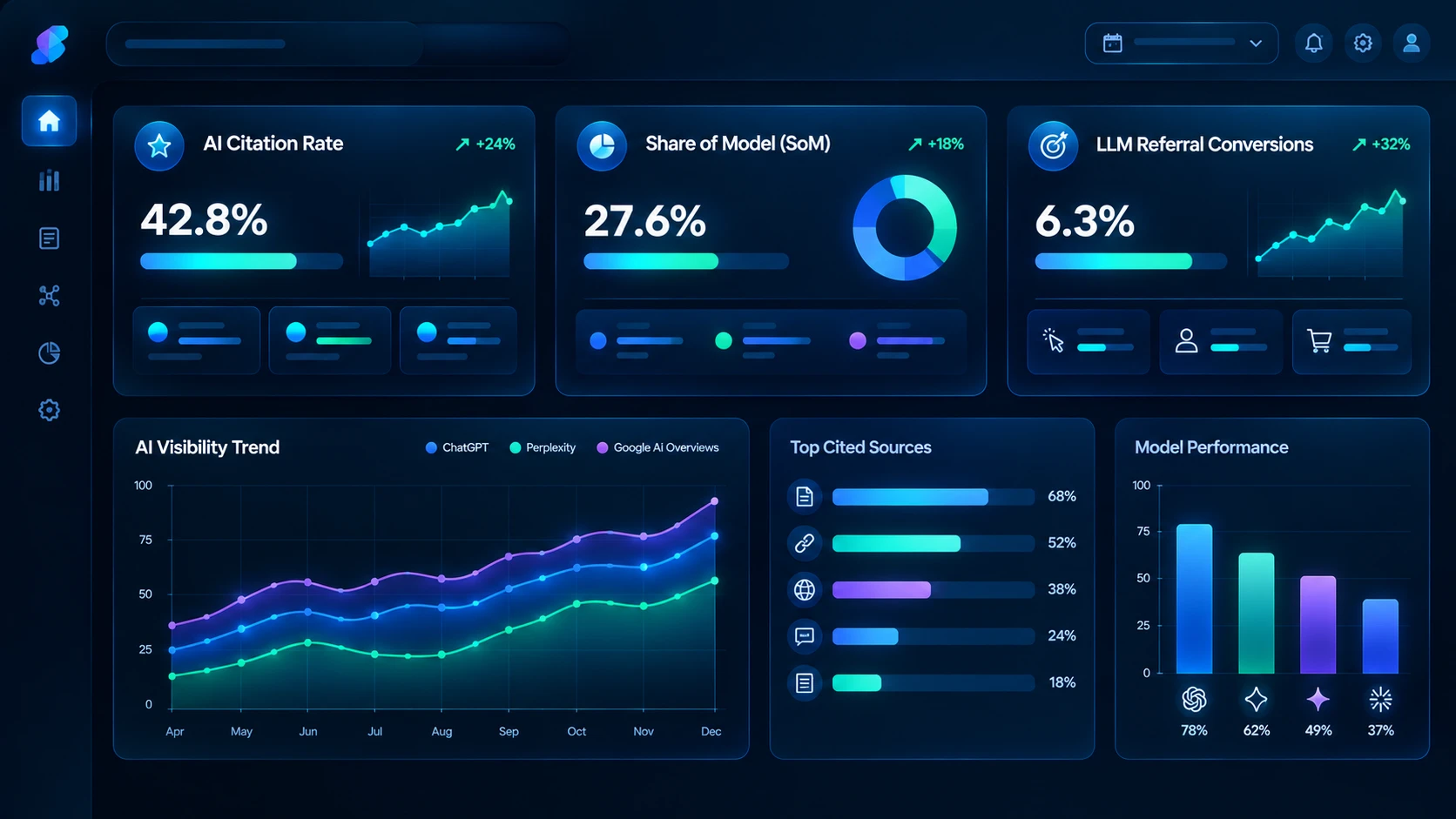
Track four metrics across your prompt panel:
AI Citation Rate: the percentage of tracked prompts where your domain is cited as a source.
Share of Model (SoM): your share of brand mentions and recommendations relative to competitors.
Citation velocity: net-new citations gained per 30 days, the leading indicator of whether your content changes are working.
LLM referral conversions: pipeline and revenue from AI-referred sessions, plus self-reported attribution such as “How did you hear about us?”
Answers are non-deterministic. Run each prompt several times and judge trends, not single outputs.
Report these four metrics quarterly, alongside branded search volume and AI-touched pipeline, so leadership sees influence on revenue rather than only traffic.
Measurement has blind spots. Google counts AI feature traffic inside overall Search Console reporting, so it is hard to isolate there. Buyers also verify AI recommendations directly: in Adobe's July 2026 consumer survey, 66% said they visit a brand's website to check one, so expect AI influence to surface as direct and branded traffic.
What AI-Referred Traffic Is Worth
Adobe's August 2026 report found that in July, AI-referred visitors to US retail sites converted 60% more often than other visitors and were 34% less likely to bounce. Adobe attributes the bounce gap to stronger content relevance and user intent. The pattern is not universal: in travel, AI-referred conversion was still 1% lower than non-AI traffic.
B2B-specific benchmarks remain thin. Validate on your own data by segmenting AI referrers in analytics and comparing pipeline quality, not form fills.
FAQ: Generative Engine Optimization for B2B Teams
How does GEO differ from traditional SEO?
SEO optimizes pages to rank and earn clicks. GEO optimizes passages, entities, and claims to be retrieved, cited, and recommended inside AI-generated answers. They share foundations, but GEO adds evidence density, entity clarity, and third-party corroboration.
Which AI platforms drive the highest-converting B2B leads?
No public benchmark yet isolates B2B lead conversion by platform. By volume, Octane11's Q2 2026 data puts ChatGPT at about 79% of B2B AI referrals in June, followed by Gemini (9.8%), Claude (4.5%), and Perplexity (4.2%). Segment each referrer in your own analytics and compare pipeline quality before shifting budget.
Does GEO replace keyword research?
No. Keyword research still reveals demand and the language buyers use. GEO extends it to full prompts and follow-up questions, so treat keywords as seeds and map them to the sub-questions engines fan out.
What is the difference between GEO and answer engine optimization (AEO)?
The terms overlap heavily. AEO usually focuses on earning direct answers and featured placements, while GEO emphasizes citations and recommendations inside generated, multi-source answers. One well-run program covers both.
How long does GEO take to show results?
Early signals can appear within weeks, because engines re-crawl and re-retrieve continuously, but no platform guarantees timing. Plan on a 90-day measurement window, then review citation velocity quarterly.
Ready to Dominate AI-Led Discovery in 2026?
Generative discovery rewards brands that are clear, corroborated, and easy for machines to cite. Build that foundation now, and you will be on the shortlist when buyers and their agents start searching.
Start by auditing your brand's semantic AI visibility across ChatGPT, Perplexity, Claude, and Google AI Overviews. A useful audit answers four questions:
Where are we cited, and where are competitors cited instead?
How do engines describe our products, pricing, and differentiators?
Which fan-out sub-questions do we fail to answer?
Which third-party sources do engines trust in our category?
Then build an omni-channel growth engine that connects content, technical SEO, earned media, and analytics.
Preesoft's comprehensive digital marketing services help B2B teams audit AI visibility, structure content for retrieval, and measure citation-driven pipeline. If you want a second opinion on where you stand, our team is ready to help.