
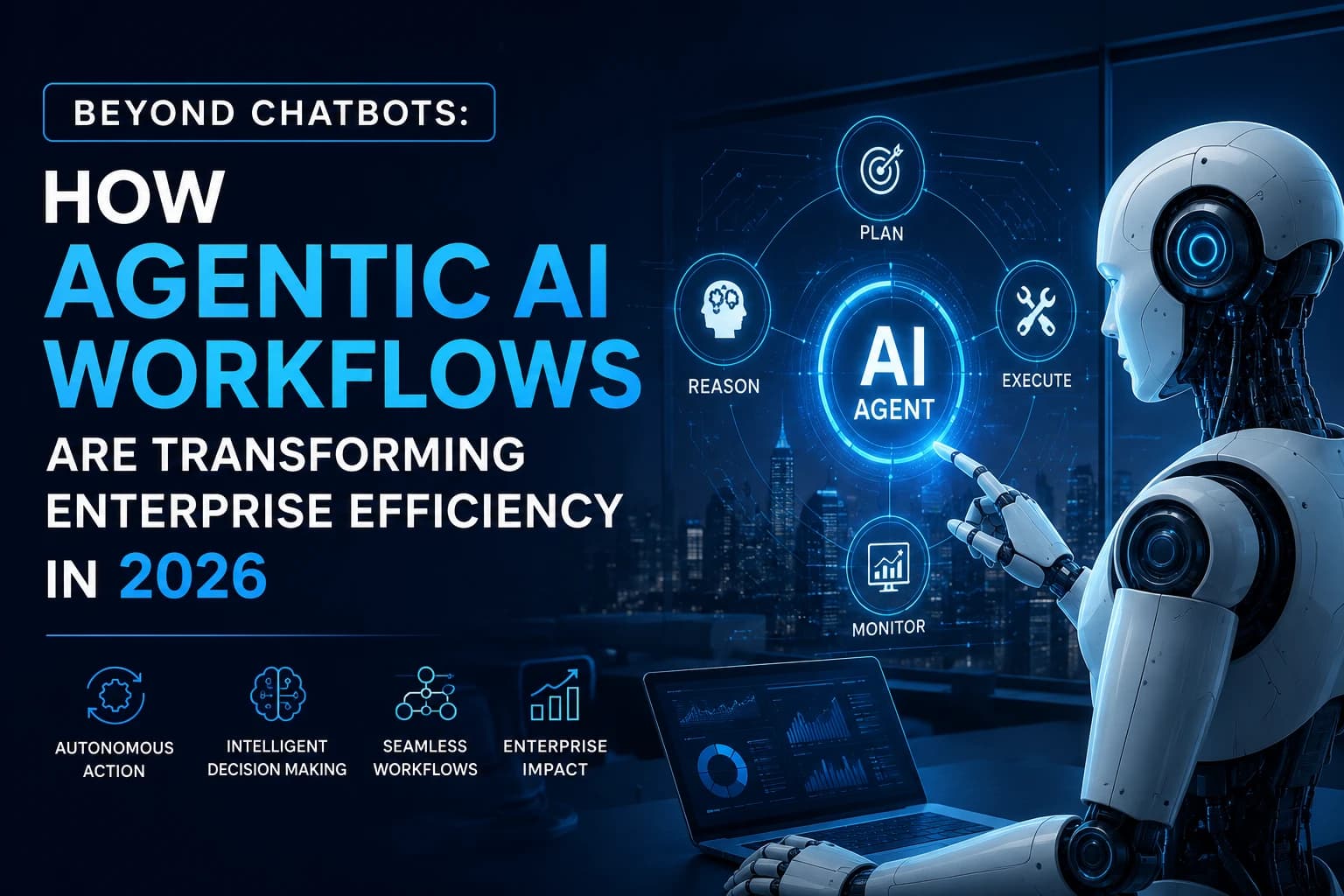
Beyond Chatbots: How Agentic AI Workflows Are Transforming Enterprise Efficiency in 2026
 By Admin
 June 26, 2026
The Evolution of AI: From Chatbots to Autonomous Agents
Three years ago, deploying a customer-facing chatbot felt like a competitive advantage. Today, it is the bare minimum.
Enterprise leaders across the UK and US are waking up to a critical reality: reactive AI tools that answer questions are no longer enough to drive operational growth. The businesses gaining ground right now are the ones deploying AI that acts — not just AI that answers.
This shift has a name: Agentic AI. And in 2026, it is no longer a futuristic concept reserved for Silicon Valley. It is an active business strategy delivering measurable efficiency gains across supply chains, finance functions, customer operations, and software delivery pipelines.
If you want to understand the foundational shift from simple chatbots to autonomous enterprise agents, our earlier deep-dive — The Era of Agentic AI: From Chatbots to Autonomous Enterprise Agents — covers the core architecture in detail. In this article, we go further: the why, the how, and the implementation roadmap for enterprise decision-makers ready to act.
What Are Agentic AI Workflows?
Agentic AI refers to AI systems that can plan, reason, and execute multi-step tasks autonomously to achieve a defined business goal — with minimal human intervention at each step.
This is fundamentally different from a traditional Large Language Model (LLM), which responds to a prompt and stops. An agentic system uses LLM orchestration — chaining multiple AI calls, tool invocations, and decision checkpoints together into a coherent workflow.
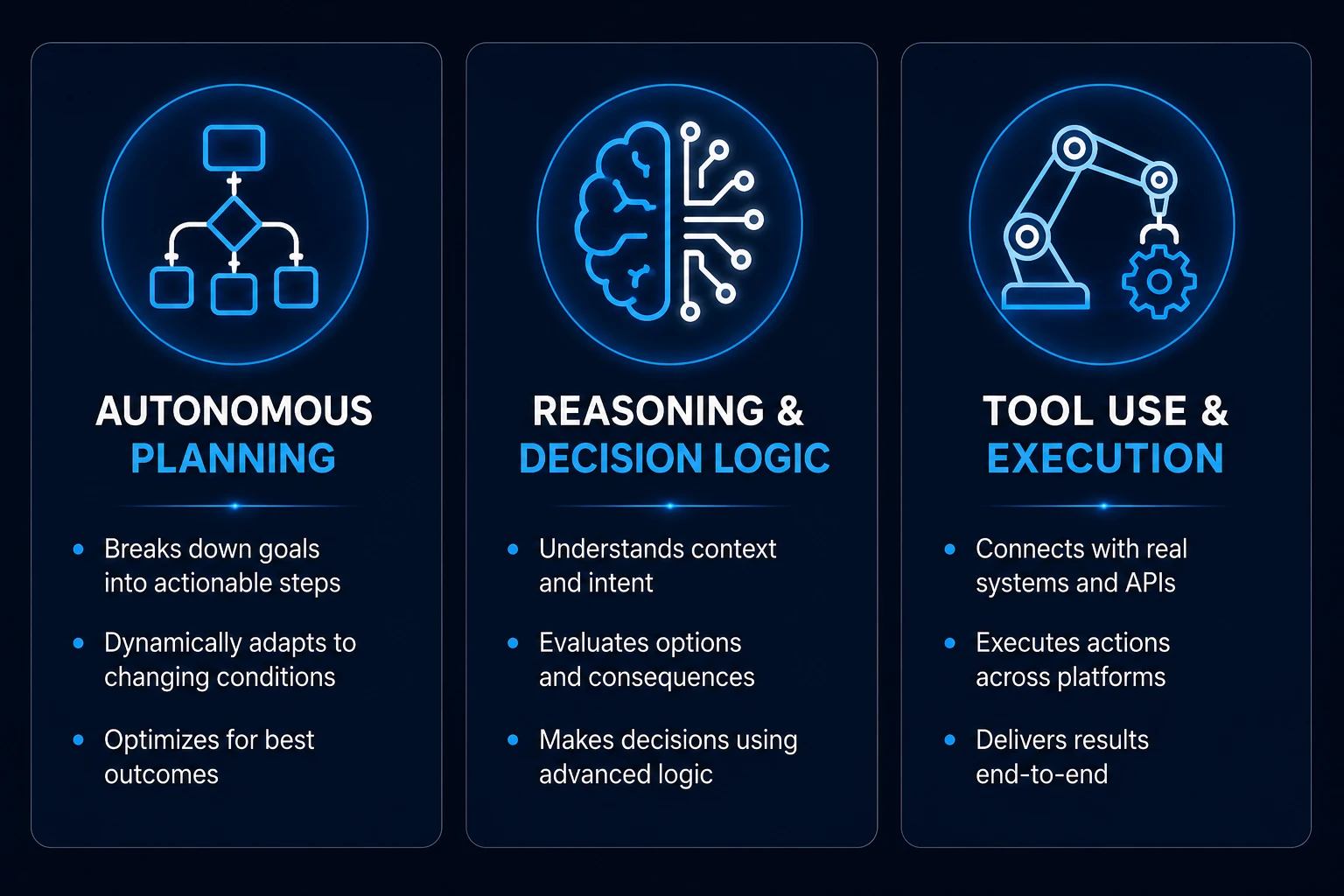
The technical distinction breaks down into three core capabilities:
Autonomous Planning: The agent breaks a high-level goal into sequenced sub-tasks, dynamically re-planning when conditions change.
Reasoning and Decision-Making Logic: Using frameworks like the ReAct (Reason + Act) pattern or chain-of-thought prompting, agents evaluate context before taking each action.
Tool Use and Execution: Agents interact with real systems — APIs, databases, ERP platforms, communication tools — to complete work rather than just recommend it.
Why Enterprises Are Adopting Agentic AI in 2026
The adoption curve is steep — and the window for first-mover advantage is closing. According to Gartner, 40% of enterprise applications will be integrated with task-specific AI agents by the end of 2026, up from less than 5% in 2025. Meanwhile, the 2026 Gartner Hype Cycle for Agentic AI reports that only 17% of organizations have deployed AI agents to date, yet more than 60% expect to do so within the next two years — the most aggressive adoption curve among all emerging technologies tracked.
The question is not whether this wave is coming. The question is whether your business will be positioned ahead of it.
Efficiency at Scale
The productivity returns from agentic AI are not marginal improvements — they represent structural shifts in operational capacity.
Real-world enterprise deployments in 2026 are already reporting:
Customer service teams saving 40+ hours per month per team through AI agents handling refunds, escalations, and omnichannel support resolution.
Finance and operations functions accelerating month-end close processes by 30–50% through automated invoicing, forecasting, and expense auditing agents.
Sales and marketing pipelines reporting 2–3x improvements in velocity through lead qualification and personalized outreach agents.
These are not aspirational projections. These are documented results from current production deployments across enterprise environments.
Reducing Human Error in Repetitive Tasks
Every repetitive, rule-based workflow is a liability when it depends entirely on human execution. Compliance checks, data entry, contract routing, procurement approvals, and onboarding sequences all carry real risk of inconsistency and error — especially at scale.
Agentic AI eliminates this variability. Workflows are executed identically every time, with full auditability. The agent does not have a bad day, miss a field, or forget to log a record. This is especially valuable in regulated industries — financial services, healthcare, legal — where process consistency is not just an efficiency concern, but a compliance requirement.
24/7 Decision-Making Capability
Human teams operate in time zones. AI agents do not.
For enterprises serving global customers or managing international supply chains, the ability to execute workflows at 3am — without escalation delays or overnight bottlenecks — has direct commercial value. An autonomous AI agent can process an urgent procurement request, respond to a high-priority support ticket, or trigger a compliance review at any hour, any day of the week.
This "always-on" operational capacity is one of the strongest business cases for agentic adoption, particularly for UK firms managing US and APAC operations, or vice versa.
Use Cases: How Agentic AI Works in Real Business
Agentic AI is not a single-purpose tool. Its value compounds when applied to end-to-end workflows that span multiple systems and decision points. Here are the enterprise use cases delivering the strongest returns right now:
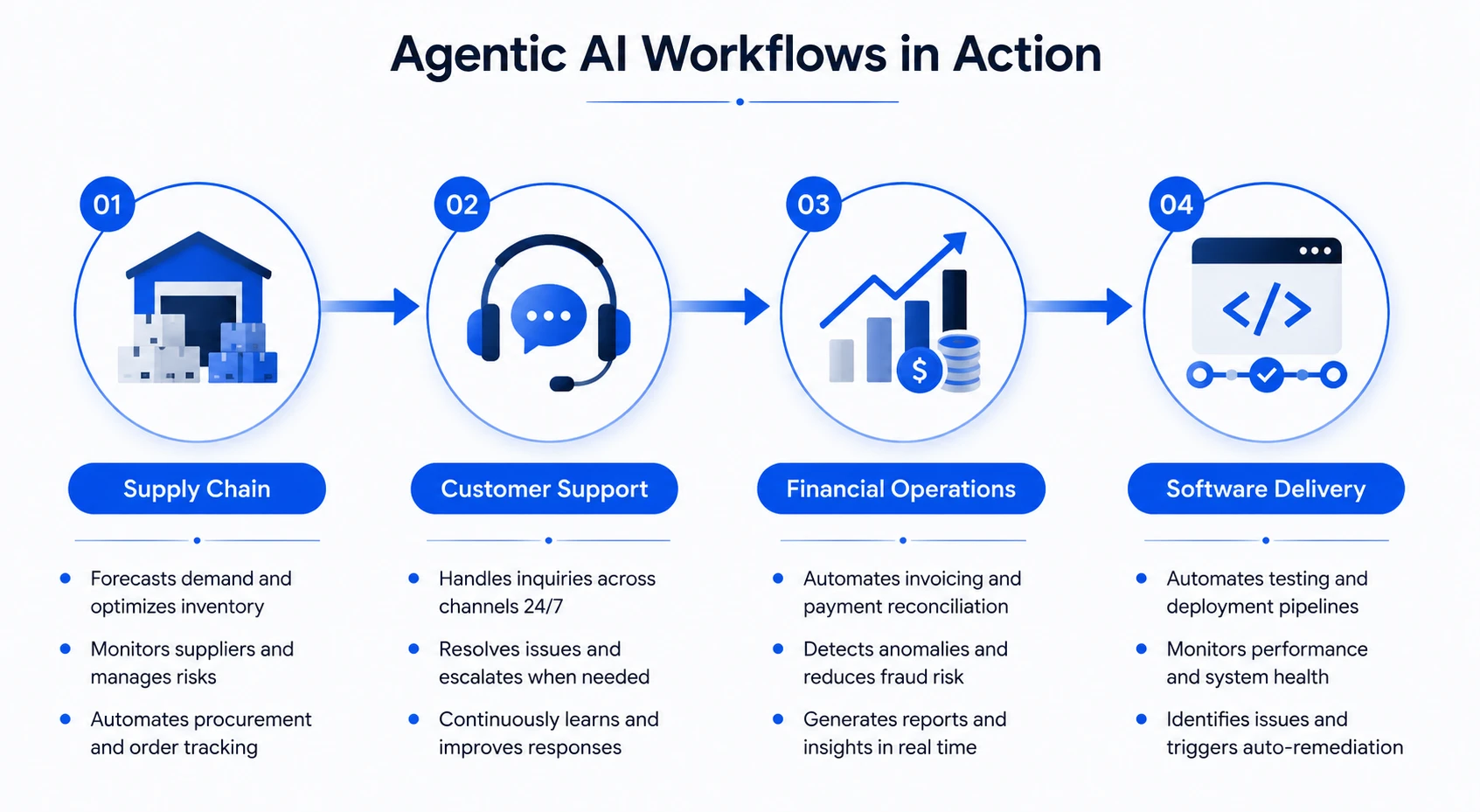
Supply Chain Management: AI agents monitor inventory levels, detect reorder triggers, query vendor APIs for pricing, generate and route purchase orders, and update ERP records — all without a human completing each handoff. What previously required hours of cross-departmental coordination now runs as a continuous background process.
Customer Operations: Autonomous support agents classify incoming tickets, retrieve account data, verify policy eligibility, generate personalised responses, and escalate only when human judgement is genuinely required. Gartner predicts that by 2029, agentic AI will autonomously resolve 80% of common customer service issues without human intervention — delivering a 30% reduction in operational costs.
Financial Processes: From invoice matching to regulatory reporting, AI agents are replacing manual data pipelines with orchestrated workflows that include exception-handling logic and automatic audit trails.
Software Development Pipelines: Multi-agent systems now power code review, test generation, documentation, and deployment pipelines — with specialised agents collaborating in sequence rather than a single tool doing everything.
The Implementation Roadmap
Agentic AI is powerful, but it rewards structured deployment. Enterprises that rush to implementation without a clear strategy are the ones ending up in Gartner's cautionary analysis: over 40% of agentic AI projects are predicted to be cancelled by the end of 2027, primarily due to unclear business value and inadequate risk controls.
A deliberate, phased approach is not optional — it is the difference between production-grade automation and an expensive pilot that never scales.
Step 1: Assess Your Current Tech Stack
Before deploying AI agents, your enterprise needs a clear map of your existing systems, data flows, and integration points. Key questions to answer:
Which workflows currently require the most manual coordination across multiple tools?
Do your core systems (CRM, ERP, HRIS, ticketing) expose APIs or webhooks that agents can interact with?
Where does your data live, and how clean is it? An agentic system is only as reliable as the data it operates on.
Start with a targeted audit of two or three high-volume, rule-based processes. These are your best candidates for a first production deployment.
Step 2: Data Security Considerations
Agentic AI systems interact with sensitive enterprise data — customer records, financial information, personnel files, legal documents. This is not an area where security can be retrofitted after deployment.
Before any agent goes into production, your implementation plan must address:
Access controls: What data and systems is each agent permitted to interact with? Principle of least privilege applies.
Audit trails: Every agent action should be logged with full traceability for compliance and debugging.
Human approval gates: Identify decision points — particularly in finance, HR, and legal — where a human must remain in the loop before an agent proceeds.
Data residency: For UK enterprises post-Brexit, ensure AI processing complies with UK GDPR requirements, especially if your AI infrastructure is US-hosted.
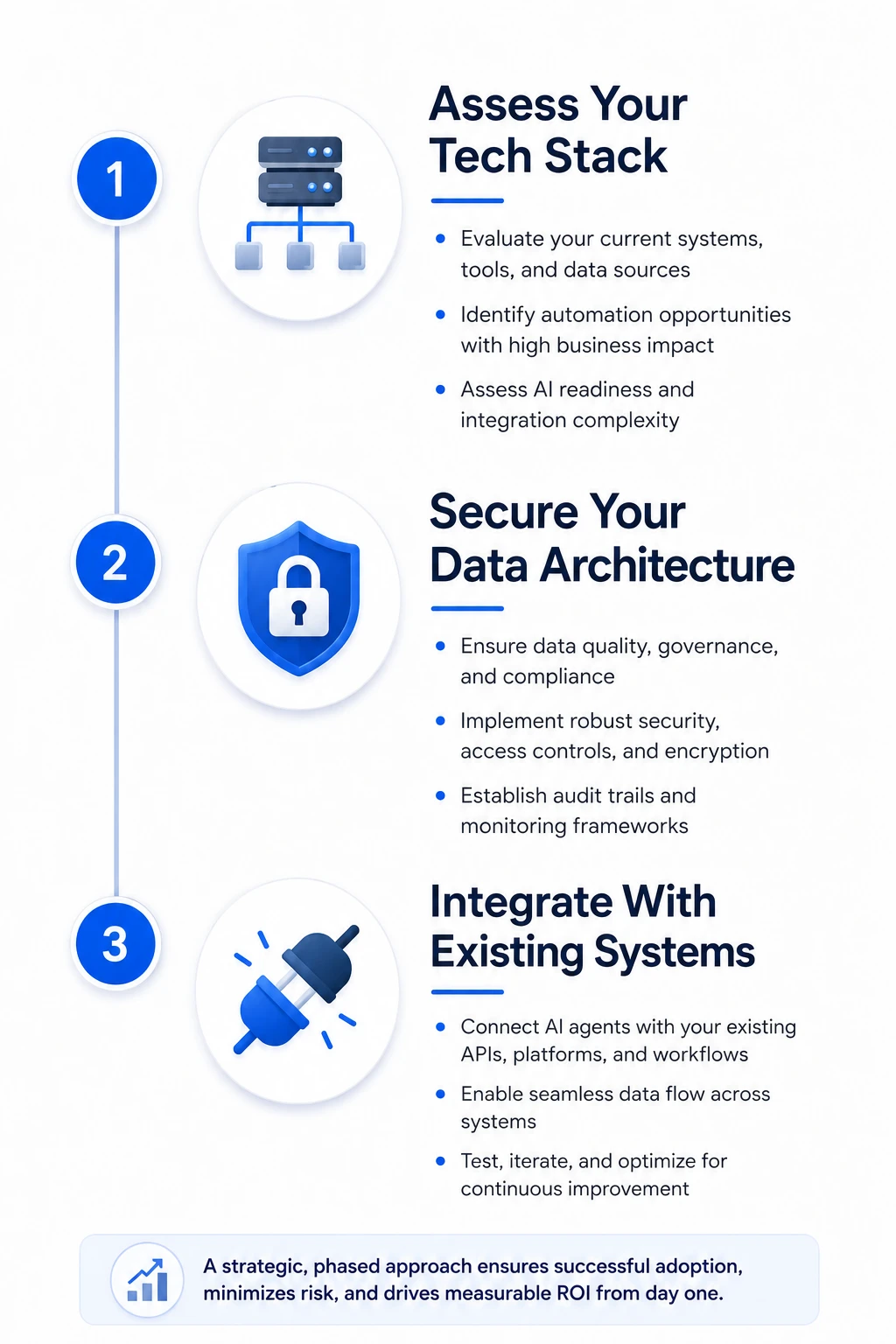
Step 3: Integrating With Existing Systems
Ripping and replacing your current tech stack is rarely the right move. The most successful enterprise agentic deployments work alongside existing systems — connecting to them via APIs, webhooks, and middleware layers.
Your integration strategy should prioritise:
API-first connectivity to CRM, ERP, and HRIS platforms before building agent logic on top.
Orchestration layers that manage agent handoffs, context passing, and error handling across multi-step workflows.
Fallback protocols that route tasks to human queues when agents encounter edge cases outside their defined scope.
This is where many in-house implementations stall. The orchestration infrastructure is technically demanding, and getting it wrong introduces operational risk rather than reducing it.
Why Expert Partners Are Essential for Agentic AI Implementation
Building an agentic AI system is not the same as deploying a SaaS tool or integrating a pre-built chatbot. It requires expertise across LLM orchestration, workflow engineering, API integration, security architecture, and continuous evaluation — simultaneously.
Most in-house engineering teams face three critical gaps:
Orchestration depth: Designing reliable multi-step agent workflows that handle real-world variability, edge cases, and failure modes requires specialised experience that most teams are still developing.
Model selection and evaluation: Choosing the right foundation models, fine-tuning approaches, and evaluation frameworks for specific enterprise use cases is not a one-time decision — it requires ongoing iteration.
Governance frameworks: Ensuring agents operate within defined boundaries, produce auditable outputs, and comply with regulatory requirements is a discipline in its own right.
These are not problems that enthusiasm and documentation can solve. They are problems that require practitioners who have built and shipped agentic systems in production environments.
Enterprises that partner with expert implementation teams consistently move from proof-of-concept to measurable ROI faster — and with significantly lower risk of becoming part of the 40% cancellation statistic.
If you are evaluating your agentic AI strategy, speak to practitioners who have done it before. Our team has deep expertise in designing and deploying enterprise-grade AI systems tailored to your existing infrastructure. Explore our AI and Machine Learning Services to understand how we approach implementation from architecture through to production.
Future Trends: What to Expect in Late 2026 and Beyond
The agentic AI landscape is evolving rapidly. Here is what enterprise leaders should be watching in the second half of 2026 and into 2027:
Multi-Agent Orchestration at Scale: Both Gartner and Forrester identify 2026 as the breakthrough year for multi-agent systems, where specialised agents collaborate under centralised coordination. By 2028, these ecosystems will power complete business functions — not just individual workflows.
Physical AI Integration: Forrester highlights "physical AI" as the next frontier — agentic systems that coordinate not just digital workflows but robotics, IoT sensors, and physical supply chain operations in real time. For manufacturing and logistics enterprises, this is a significant near-term opportunity.
Guardian Agents and Governance Infrastructure: As autonomous decision-making scales, governance becomes non-negotiable. Gartner projects that dedicated governance and security profiles will become central to enterprise agentic deployments — not as an afterthought, but as core infrastructure. Guardian agents — AI systems designed to monitor, audit, and correct other agents — are projected to capture 10–15% of the agentic AI market by 2030.
Autonomous Day-to-Day Decisions: Gartner predicts that by 2028, at least 15% of day-to-day business decisions will be made autonomously through agentic AI, up from essentially zero in 2024. The enterprises that have operational frameworks in place by then will be positioned to scale that number further and faster.
Conclusion: The Competitive Advantage Belongs to Those Who Move Now
Agentic AI is not a future technology. It is a present-tense operational strategy — one that is already separating enterprises into two categories: those building leaner, smarter operations, and those watching from the sidelines.
The data is unambiguous. The market is moving. The only variable is where your organisation sits on the adoption curve when the next phase accelerates.
The businesses that will lead in 2027 and beyond are the ones investing in the right infrastructure, the right governance frameworks, and the right implementation partnerships today.
The question is no longer whether Agentic AI belongs in your enterprise. The question is how quickly you can deploy it responsibly — and what that competitive head-start is worth.
Ready to Build Your Agentic AI Strategy?
Deploying autonomous AI workflows at enterprise scale requires more than technology — it requires a trusted implementation partner with proven experience across LLM orchestration, enterprise integration, and production-grade governance.
Talk to our AI specialists today and get a tailored assessment of where Agentic AI can deliver the fastest, most measurable ROI for your specific business operations.