
Legacy to API-First: Modernizing Enterprise Data Pipelines for AI-SaaS Readiness (2026 Guide)
 By Admin
 July 10, 2026
Legacy to API-First: Modernizing Enterprise Data Pipelines for AI-SaaS Readiness
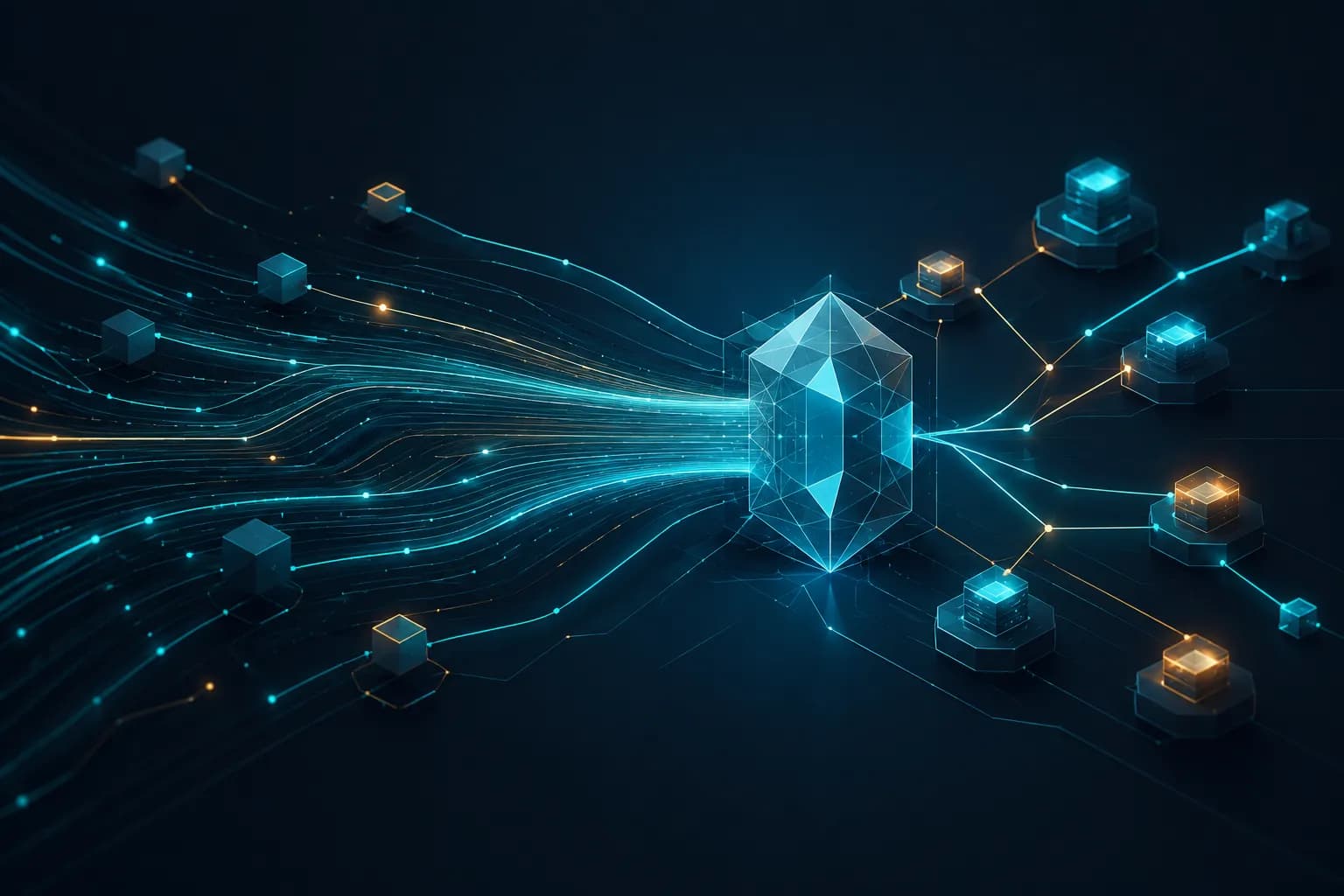
AI-SaaS data pipeline readiness means restructuring how an enterprise captures, moves, and exposes its data — shifting from scheduled batch extraction to continuous, event-driven APIs that an LLM orchestration layer can query in real time. It's the difference between an AI agent reasoning over what happened last night and one reasoning over what's happening right now. For most enterprises still running nightly ETL, that gap is the single biggest blocker between a GenAI pilot and a production deployment.
This guide walks through modernizing enterprise data pipelines end to end: what's actually broken, why it derails semantic AI queries specifically, and the concrete architectural sequence that gets a legacy estate to API-first. We'll trace it through a composite, hypothetical case — a transatlantic financial services provider we're calling Northbridge Financial, built from patterns common across UK/US regulated industries.
The 2026 Legacy Bottleneck: Why Modernizing Enterprise Data Pipelines Can't Wait
Northbridge Financial's data estate looks like most 15-year-old financial services stacks. A core policy and claims system feeds a nightly batch ETL job into a central warehouse, which analysts query the next morning. That worked fine for quarterly reporting.
It does not work for an LLM-powered claims-triage agent that's supposed to tell a customer, in real time, whether their claim is already flagged for review.
The symptoms show up fast once you try to bolt AI onto a batch architecture:
Retrieval-augmented generation (RAG) pipelines pull from an index that's up to 24 hours stale, so the agent confidently cites a policy status that changed that morning.
Data lineage latency compounds — nobody can say with confidence which upstream system a given field originated from, or when it last changed.
Every new AI use case spawns another point-to-point extract, adding to monolith-to-modular transition debt instead of resolving it.
This isn't a hypothetical inconvenience. Gartner's most recent analysis of generative AI implementations puts the proof-of-concept abandonment rate at 50% or higher, with poor data quality named consistently as one of the top drivers — alongside inadequate risk controls, escalating costs, and unclear business value as detailed in the Gartner GenAI Project Failure Report.
For a CTO staring down a board mandate to "do something with AI," that's not an abstract statistic. It's the most likely failure mode for whatever pilot is currently in flight.
The deeper issue is architectural, not tooling. Nightly batch ETL was built to answer "what happened," in bulk, on a schedule.
Agentic orchestration layers need to answer "what's true right now" — and no amount of faster batch jobs closes that gap. The fix isn't a quicker version of the old pattern; it's API-first data architecture replacing scheduled extraction as the system of record for change.
Why Untransformed Pipelines Corrupt and Delay Semantic AI Queries
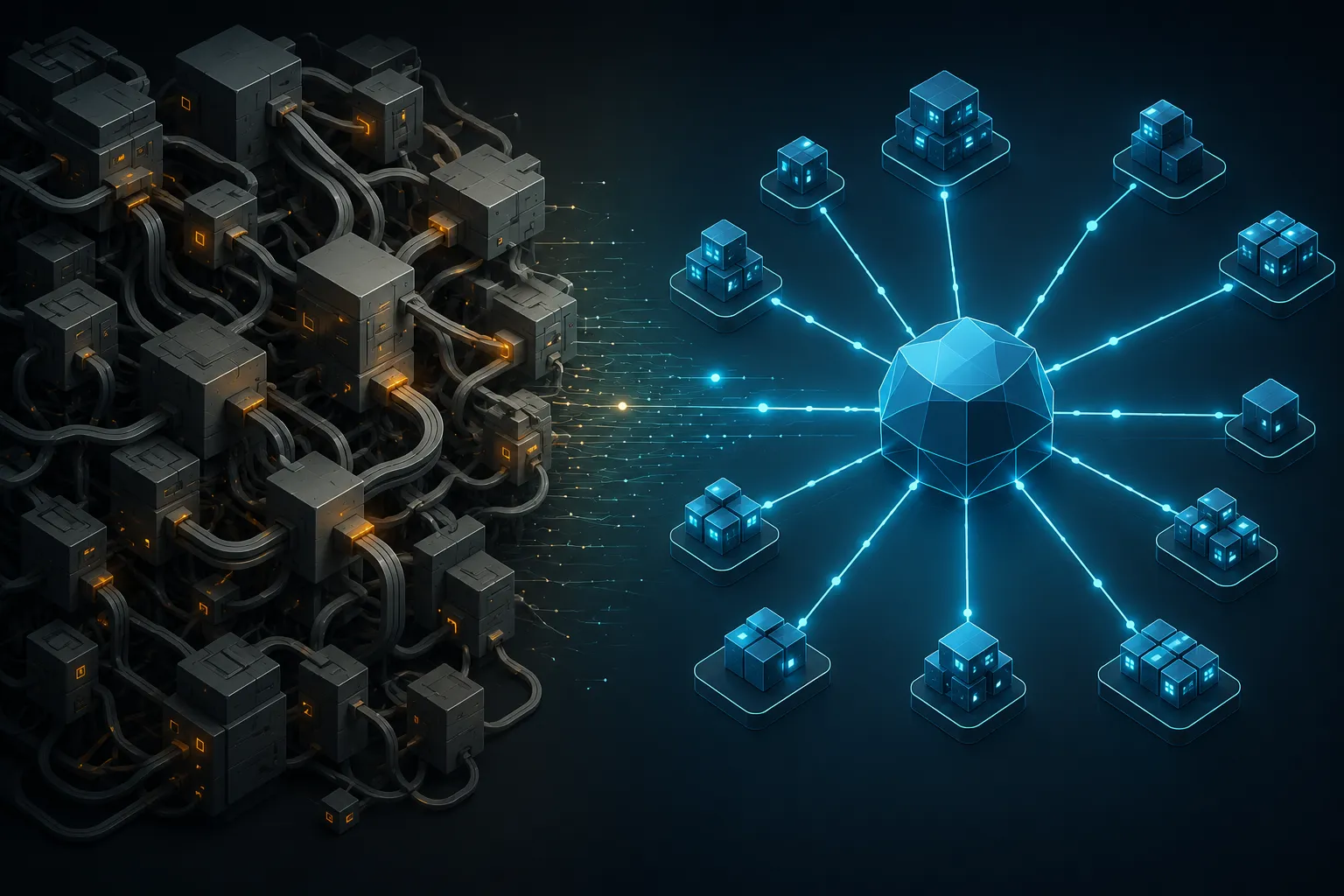
A batch-fed vector index isn't just slow — it actively produces wrong answers with high confidence, which is worse than no answer at all. When Northbridge's claims agent embeds and indexes documents once a night, any claim filed, updated, or closed during business hours is invisible to the model until the next run. The agent doesn't know it's wrong; it just answers anyway.
Three specific failure patterns show up when RAG and agentic systems sit on top of legacy pipelines:
Semantic drift — the vector index and the source-of-truth database quietly disagree, and nothing flags it.
Context fragmentation — data lives across five systems with five different refresh cadences, so the agent stitches together a partially current answer and delivers it with full confidence.
Chatty, unoptimized endpoints — instead of a governed API layer, engineers wire agents directly to a sprawl of point-to-point database connections and legacy SOAP services, each call adding latency and cost.
That last point compounds fast. An orchestration engine making dozens of small, unbatched calls across distributed infrastructure racks up data egress optimization problems — and a FinOps multi-cloud data visibility gap — long before anyone notices the monthly invoice. It's a dynamic we've broken down in detail in the 2026 multi-cloud FinOps challenge: navigating the hidden costs of distributed SaaS architecture.
The trust cost is just as real as the financial one. McKinsey's 2026 research on enterprise AI found that security and risk concerns — not regulatory uncertainty, not technical limitations — are the top-cited barrier to scaling agentic AI, reported by nearly two-thirds of respondents in the McKinsey State of AI Trust 2026 Report. An agent reasoning over stale, fragmented data is a governance risk before it's ever a productivity win.
How to Execute Modernizing Enterprise Data Pipelines: A Step-by-Step Architectural Shift
Northbridge didn't rip out its core systems. It wrapped them — a form of legacy system refactoring built on augmentation rather than risky lift-and-shift replacement.
Step 1: Wire Up Change Data Capture at the Source
Change data capture (CDC) reads the transaction log of the source database directly and emits a change event the instant a row is inserted, updated, or deleted — no polling, no nightly job. For Northbridge, that meant instrumenting the core policy and claims database with CDC connectors without touching the mainframe's business logic itself.
Every policy update, claim status change, and payment event now emits a stream event within seconds of occurring.
Step 2: Stand Up an Event Backbone
Those CDC events need somewhere to land. Northbridge routed them through a Kafka cluster — Pulsar is the equivalent choice for teams prioritizing multi-tenancy and geo-replication out of the box — which became the new system of record for change, distinct from the database that remains the system of record for state.
This is the pivot that makes event-driven data pipelines possible in the first place. Once change is a stream instead of a nightly snapshot, any number of consumers — the vector index, the GraphQL layer, a fraud model, a partner-facing API — can subscribe independently without adding load to the source system.

Step 3: Federate the API Layer with GraphQL
Rather than exposing each legacy system's native interface directly, Northbridge introduced a GraphQL federation layer that presents policy, claims, and customer data as a single unified graph — while each underlying domain team keeps ownership of its own subgraph.
This is where the data mesh philosophy earns its keep: policy, claims, and customer data become independently owned data products with clear contracts, rather than three teams fighting over one shared warehouse schema. The federation gateway handles real-time API normalization, so consuming applications never see the seams between systems.
Step 4: Index for Semantic Retrieval
With change events flowing continuously, the vector database indexing job subscribes to the event stream instead of running as a nightly batch. This is the semantic search data prep work — embedding and indexing — happening within seconds of a change instead of hours after it, closing the gap that was producing confidently wrong answers.
Step 5: Govern Cross-Border Flows Before You Expose Them
None of this matters if it isn't compliant, and Northbridge's UK/US footprint makes that non-trivial. The compliance picture it had to design around, as of mid-2026:
UK/EU side: The UK's Data (Use and Access) Act 2025 came into force in stages through early 2026, replacing the prior "essentially equivalent" test for international data transfers with a new standard requiring that a receiving jurisdiction's protections be "not materially lower" than the UK GDPR's per the official UK ICO / DUAA Guidance. That's a meaningfully different bar to document than the pre-2026 regime.
US side: More than 20 US states now have comprehensive consumer privacy laws in effect, each with its own thresholds, opt-out mechanisms, and enforcement posture, with no federal preemption in sight according to the US State Privacy Law Tracker.
Governance framework: Northbridge mapped its API exposure decisions against the NIST AI Risk Management Framework's Govern–Map–Measure–Manage structure, using it as shared vocabulary between engineering, legal, and risk teams rather than a checkbox exercise (see the NIST AI RMF Reference).
The practical upshot: every field exposed through the new GraphQL layer gets tagged with jurisdictional metadata before go-live, so downstream consumers — including any LLM orchestration engine — inherit the compliance boundary automatically instead of relying on someone remembering it later.
The Future: Autonomous, Self-Healing Data Pipelines
The next stage beyond event-driven APIs is pipelines that monitor and repair their own data quality without a human paging on-call. Early versions of this are already in production at data-mature enterprises: anomaly detection models that flag schema drift or a broken upstream contract before it corrupts a downstream index, and automated rerouting when a data mesh node degrades.
FinOps teams are already living a preview of this shift. The share of practitioners actively tracking AI-related cloud costs climbed from roughly 31% in 2024 to 98% in 2026, according to the FinOps Foundation's most recent annual survey published in the State of FinOps 2026 Report — a sign of how quickly AI workloads are becoming infrastructure that needs to be governed like any other critical system, not a side experiment.

For enterprises building the CDC-to-vector-index pipeline described above, a self-healing layer is a natural next investment: the same event backbone feeding an LLM orchestration engine can feed a monitoring model trained to recognize its own data quality degrading in real time.
Frequently Asked Questions
What does "AI-SaaS data pipeline readiness" actually mean?
It means your data layer can deliver current, trustworthy information to an AI system on demand, via APIs and event streams, rather than on a batch schedule. If your freshest data is reliably a few hours old, you're not there yet.
How long does modernizing enterprise data pipelines from batch ETL to event-driven APIs typically take?
For a single domain, like Northbridge's claims system, CDC-to-event-backbone can land in 8–12 weeks. Federating the full API layer across multiple domains, plus compliance tagging, is usually a 6–12 month program depending on how many legacy systems are involved.
Do we need a full data mesh to make our data AI-ready?
No. CDC and an event backbone deliver most of the latency win on their own. Data mesh principles — domain ownership, data as a product — matter most once three or more teams are contending for the same shared data, which is usually when a single centralized model starts breaking down.
How do we stay compliant with GDPR, the UK DUAA, and US state privacy laws when exposing data via APIs?
Tag data with jurisdictional and sensitivity metadata at the point of ingestion, not at the point of export. Enforcing residency and consent rules at the API gateway, based on that metadata, is far more auditable than reconstructing compliance after the fact.
What's the real difference between CDC and traditional batch ETL for AI workloads?
Batch ETL extracts data on a schedule, so freshness is capped by how often the job runs. CDC reads the database's transaction log directly and emits an event the moment a change happens, so downstream consumers, including a vector index, stay continuously current instead of waiting for the next run.
Ready to Validate Your Architecture?
Every pattern above — CDC, event backbone, GraphQL federation, compliance-tagged data products — sounds straightforward on a whiteboard and is genuinely hard to sequence correctly across a live production estate without breaking something a regulator or a customer will notice.
Before your next GenAI initiative becomes another line in Gartner's abandonment statistics, it's worth having your data layer independently assessed against the failure modes outlined above. Our team provides comprehensive SaaS Architecture & Development engagements that start with an architectural readiness audit — mapping your CDC coverage, event backbone, API federation layer, and compliance posture against what AI-SaaS workloads actually require, before a single line of migration code gets written.