
The AI Velocity Gap: Why Enterprises are Pivoting to AI-Augmented Engineering Pods in 2026

 By Admin
 July 16, 2026
Every CTO has felt it: a competitor ships a feature in the time it takes your team to schedule the kickoff call. That lag has a name now.
The AI velocity gap is the widening productivity and delivery-speed delta between modern enterprises utilizing AI-augmented engineering pods and traditional companies still bound to legacy, headcount-based IT staffing models.
It isn't a marketing phrase. It shows up in pull request cycle times, in deployment frequency, and in how much a five-person team can absorb compared to a fifteen-person one. By mid-2026, it has become one of the clearest predictors of which enterprises out-ship their category — and which spend another budget cycle explaining a slipped roadmap.
This article breaks down what's driving the gap, what an AI-augmented engineering pod actually looks like next to a traditional staffing model, and the roadmap CTOs are using to close it.
What Is the AI Velocity Gap? (And What Is an AI-Augmented Engineering Pod?)
The AI velocity gap describes the growing distance between two ways of building software. On one side: large teams billed by the hour, coordinating through status meetings and manual handoffs. On the other: small, AI-fluent teams that ship, test, and deploy inside the same week they start.
Throughout this piece, we'll follow two illustrative organizations — LegacyCorp and VelocityTech. Neither is a real, named company; both are composites built from the productivity patterns now showing up across enterprise engineering benchmarks, used here to make an abstract gap concrete.
An AI-augmented engineering pod is the structural unit closing that gap. Instead of a large offshore team organized around headcount, a pod typically looks like:
3 to 5 engineers, not 10 to 15
Fluent in AI-native tooling — Cursor, GitHub Copilot, and agentic coding assistants — as a default part of the workflow, not a bolt-on
Paired with automated QA and security testing instead of manual regression cycles
Measured on shipped outcomes and DORA metrics, not billed hours
Gartner's own research backs the shape of this shift. Analysts project that by 2030, 80% of organizations will evolve their large software engineering teams into smaller units augmented by AI — not primarily to cut headcount, but to compress delivery cycles that used to take months into days.
Why the Gap Is Reaching a Boiling Point in 2026
For the first few years of the generative AI era, simply "using AI" was a differentiator. That's no longer true. McKinsey's 2025 State of AI survey found that 88% of organizations now regularly use AI in at least one business function — yet just 39% report any measurable EBIT impact at the enterprise level.
That gap between adoption and impact is exactly where the AI velocity gap lives. Handing a legacy team a Copilot license doesn't restructure how they work.
McKinsey's November 2025 analysis of nearly 300 public companies found that simply giving developers AI tools doesn't meaningfully move the needle — the organizations pulling ahead rearchitected their entire delivery lifecycle around AI, not just their IDEs. Top-quintile performers in that study saw 16–30% gains in productivity and time-to-market, and 31–45% gains in software quality.
LegacyCorp, in our illustration, sits at the median: five offshore backend developers, billed hourly, each using AI tools individually and inconsistently. Environment setup alone eats real time every sprint, and every pull request queues for manual review. VelocityTech sits in that top quintile: three engineers, one shared AI-native workflow, self-documenting code, and automated QA gating every merge.
The pain point isn't talent scarcity — it's structure. Traditional IT staff augmentation still largely bills by the hour, which quietly rewards slow environment setup and manual QA instead of shipped outcomes. Enterprises still anchored to legacy IT staffing models are, in effect, paying a premium to move slower than their AI-fluent competitors.
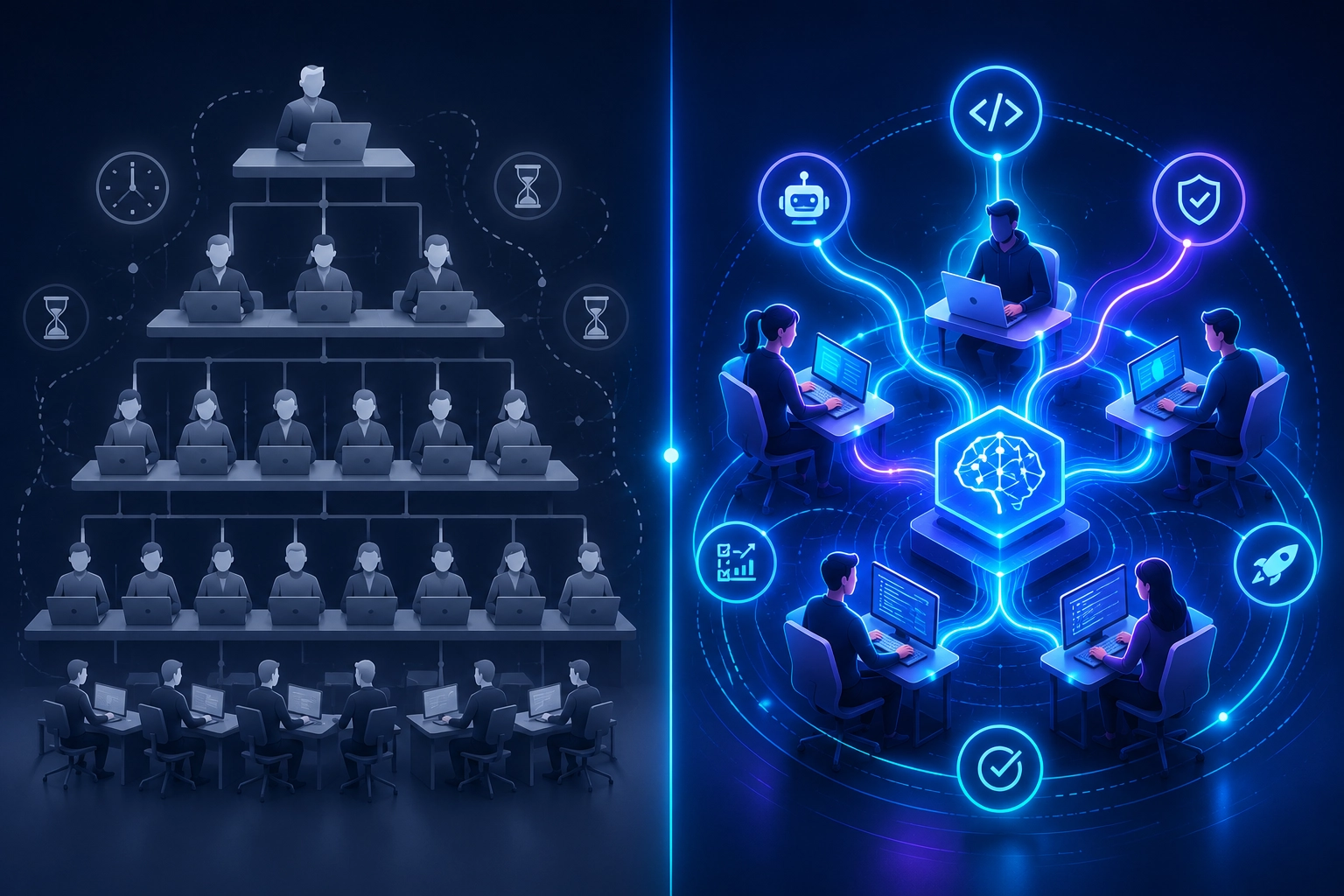
Anatomy of an AI-Augmented Engineering Pod: LegacyCorp vs. VelocityTech
The clearest way to see the AI velocity gap is side by side. Picture both organizations tackling an identical integration project — a new payments API touching billing, notifications, and reporting.
LegacyCorp's Build
5 offshore mid-level backend developers, billed hourly
Manual environment setup, repeated every sprint
Manual PR review and manual regression testing
Pull requests sit in review for 9.6 days on average
Delivery: roughly six weeks, plus a post-launch security patch cycle
VelocityTech's Build
3 engineers fluent in Cursor, GitHub Copilot, and automated QA pipelines
Self-documenting code and AI-assisted test generation
Automated security scanning gating every merge
Pull requests move from open to merge in roughly 2.4 days
Delivery: a comparably scoped release in days, not weeks, with no unplanned overhead
That contrast is illustrative rather than a documented audit of two real companies — but it tracks with what's showing up in real enterprise data. GitHub's randomized controlled trial with Accenture found Copilot-assisted teams saw an 8.69% increase in pull requests per developer, a 15% improvement in pull request merge rate, and an 84% increase in successful builds. AI-augmented throughput doesn't have to come at the cost of code quality; in that study, it moved in the same direction.
The real difference isn't the AI tools themselves — both companies technically have "access to AI." The difference is engineering pod structure: VelocityTech built a workflow where AI is load-bearing across the whole lifecycle, not a suggestion box bolted onto an unchanged process.
Measuring What Matters: DevEx, DORA Metrics, and Cognitive Load Reduction
Raw hours billed was always a poor proxy for value delivered. The developer productivity stats that actually predict delivery speed in 2026 look different from lines-of-code counts — most CTOs now lean on two frameworks: DevEx (Developer Experience) and the DORA metrics.
DORA — Deployment Frequency, Lead Time for Changes, Mean Time to Recover, and Change Failure Rate — has tracked software delivery performance for a decade. Google Cloud's 2025 DORA report, based on nearly 5,000 technology professionals, found AI adoption is now positively correlated with delivery throughput. But it flagged a catch: AI adoption still carries a negative relationship with delivery stability unless it's paired with strong version control, automated testing, and fast feedback loops.
The report's central finding is worth repeating to any CTO evaluating vendors: AI doesn't fix a team, it amplifies what's already there. A high-functioning pod gets faster. A dysfunctional one gets faster at shipping bugs.
This is also where cognitive load reduction earns its place in the conversation. Freeing developers from boilerplate isn't only a productivity story — it's a retention story. Engineers who spend their day on architecture and judgment calls, rather than repetitive scaffolding, report higher satisfaction and tend to stay longer, which compounds into less re-hiring and more institutional knowledge retained inside the pod.
To understand how high-speed software cycles work at the code level, explore our deep dive on AI-Native Development: The Future of High-Speed Software Engineering.
The Trust Problem: Is AI-Generated Code Actually Safe?
No CTO evaluating AI-augmented engineering pods should skip this section. AI-generated code is not a silver bullet, and pretending otherwise is how enterprises end up with a very fast pipeline shipping very real vulnerabilities.
Where the Real Risk Comes From
The data supports real caution here. Academic testing of AI coding assistants by researcher Pearce et al. found that roughly 40% of the programs generated contained exploitable vulnerabilities, with notably higher rates in lower-level languages like C. Separately, Gartner's Predicts 2026 research warns that by 2028, unmanaged "prompt-to-app" development by citizen developers will drive a 2,500% increase in software defects if left ungoverned.
Even productivity claims deserve scrutiny. A widely cited 2025 randomized controlled trial from METR found that experienced open-source developers using AI tools were actually 19% slower at completing real tasks on their own mature codebases — despite believing, both before and after, that AI had sped them up.
That doesn't mean AI coding tools don't work. It means unmanaged, individual-level AI usage without the right workflow can create a false sense of velocity, which is arguably more dangerous than no velocity at all.
Building the Digital Immune System
This is exactly why mature AI-augmented pods embed DevSecOps rather than bolting security on at the end. Gartner has its own name for the resulting architecture: the digital immune system — a combination of observability, automated testing, and AI-augmented security scanning designed to make applications self-detecting and self-healing against defects.
In practice, that means:
Automated SAST/DAST scanning on every pull request, not a quarterly audit
AI-specific security testing tools trained to catch failure patterns unique to LLM-generated code
Human review gates on anything touching authentication, payments, or data access
Building this out is its own discipline, which requires moving toward a Security-First Architecture: Building Digital Immune Systems in the Age of AI Cyber Threats (2026 Guide).

How to Close the Gap: A CTO's Migration Roadmap
Moving LegacyCorp-style staffing toward a VelocityTech-style pod isn't a weekend project, but it doesn't require a multi-year transformation program either. Most enterprises can pilot this in a single quarter.
Audit your current PR cycle time and DORA baseline. You can't close a gap you haven't measured. Pull the last two quarters of Lead Time for Changes and Change Failure Rate before changing anything.
Pilot one pod, not the whole org. Stand up a 3-to-5-person pod on a single product line, with AI-native tooling and the authority to change its own workflow.
Redesign the workflow before adding tools. Per McKinsey's research, tool access without lifecycle redesign barely moves the needle. Map ideation, coding, testing, and deployment as one AI-assisted flow, not four separate handoffs.
Embed security from day one. Wire in automated scanning and AI-specific testing tools before the pilot ships to production, not after an incident.
Re-measure against the same DORA baseline at 90 days. Compare pod output to legacy-team output on equivalent work, not just raw activity.
Scale the model, not just the headcount. Replicate the pod structure across product lines rather than growing any single pod past five engineers.
The most common failure pattern is skipping step 3: buying licenses, seeing a small bump, and concluding AI-augmented development "doesn't work for us." It isn't the tools. It's staffing the same legacy structure with faster typists.
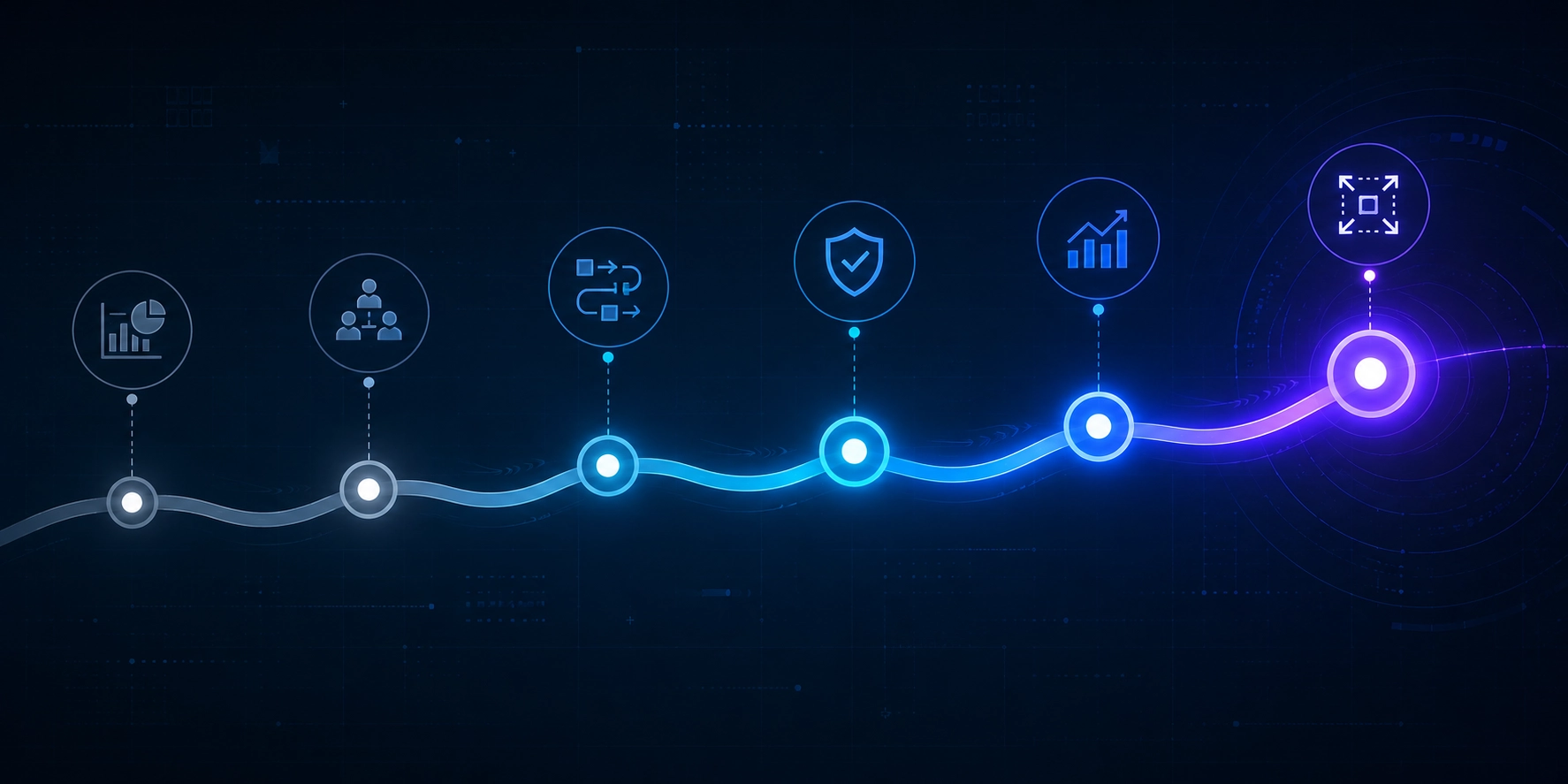
The Future: Multi-Agent Systems and Domain-Specific Language Models
The pod structure described above is roughly where leading enterprises sit in mid-2026. It isn't the endpoint.
Gartner projects that by the end of 2026, 40% of enterprise applications will integrate task-specific AI agents, up from under 5% in 2025. The next evolution of the AI-augmented pod isn't three engineers each directing one assistant — it's a small team orchestrating multi-agent systems, where specialized agents handle code generation, testing, and deployment as a coordinated pipeline, with engineers reviewing outcomes rather than authoring every line.
Running alongside that shift are domain-specific language models (DSLMs) — models fine-tuned on a narrower, industry-specific dataset rather than general-purpose code. Gartner expects DSLMs to outperform generic large language models on accuracy, compliance, and cost in regulated industries like finance and healthcare, precisely because they're trained on that domain's vocabulary and constraints.
The practical implication for CTOs: the pod built in 2026 should be able to absorb agent orchestration and DSLM adoption without a full second restructuring. That means investing in workflow and governance now, not just today's tool stack.
Frequently Asked Questions
How do AI-augmented engineering pods differ from traditional IT outsourcing? Traditional IT outsourcing bills for time — headcount, hours, seats. An AI-augmented engineering pod is a small, cross-functional team (typically 3–5 engineers) measured on shipped outcomes and DORA metrics, using AI-native tooling as a default part of every stage of the software development lifecycle rather than as an optional add-on.
How do you measure developer productivity in the age of AI coding assistants? Lines of code and hours billed are no longer reliable proxies. Leading teams track pull request cycle time, PR merge rate, Deployment Frequency, Lead Time for Changes, Change Failure Rate, and code retention rate — how much AI-suggested code actually survives to production — alongside qualitative DevEx surveys.
What are the security risks of utilizing AI-generated code, and how do we mitigate them? AI-generated code can carry the same categories of vulnerabilities as human-written code, sometimes at a higher initial rate when unvetted. Mitigation means embedding DevSecOps into the pod itself: automated SAST/DAST scanning on every PR, AI-specific security testing tools, and mandatory human review on anything touching authentication, payments, or sensitive data — the digital immune system model.
Closing the Gap Before Your Competitors Do
The AI velocity gap isn't a future risk. It's already showing up in competitors' release notes. Enterprises still running legacy IT staffing models aren't just paying more per hour — they're structurally unable to match the delivery cadence of a properly built AI-augmented pod, no matter how many hours they bill.
Closing the gap doesn't require replacing an entire engineering organization. It requires rethinking how a small number of highly capable engineers, real AI-native tooling, and embedded security work together as one unit.
If you are ready to eliminate delivery bottlenecks and out-pace your competitors, it is time to scale your development velocity using modern staff augmentation models built specifically for the demands of 2026.