
AI Governance Frameworks for Enterprise Tech: How to Build Audit-Ready Systems for 2026 Compliance
 By Admin
 July 30, 2026
"Move fast and break things" never really applied to production infrastructure. In 2026, it has definitively stopped applying to AI, too.
For three years, enterprise AI adoption outran governance. That gap is now closing — not gently, but through court injunctions, delayed EU regulations, and boards asking CTOs a question no slide deck answers well: can you prove this system behaved the way you say it did?
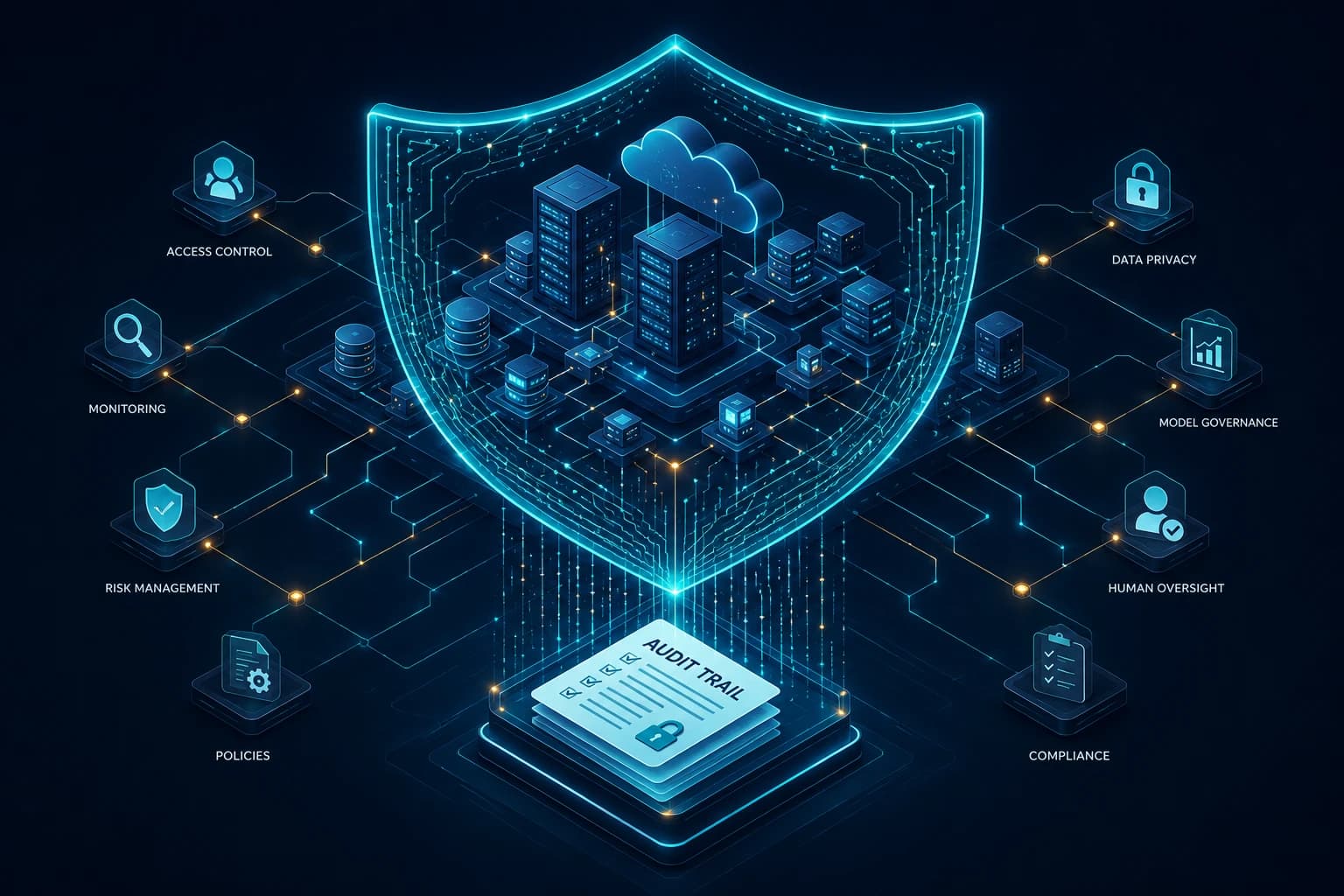
Enterprise AI governance frameworks are the structured set of policies, engineering controls, and audit mechanisms that let an organization prove — not just claim — that its AI systems behave predictably, fairly, and within regulatory bounds. Their real job in 2026 is to convert a fast-moving legal landscape into stable engineering guardrails: logging, monitoring, and override systems that keep working no matter which specific regulation happens to be in force this quarter.
That last part matters more than it sounds. Two of the regulatory dates enterprise teams have had circled on their calendars all year just moved. The engineering discipline underneath them didn't — and that gap is exactly what this guide is about.
The 2026 Regulatory Landscape: What Every Enterprise AI Governance Framework Must Account For
If your compliance roadmap still says "high-risk AI obligations enforced August 2, 2026," it needs an update. Here is the landscape as it actually stands in late July 2026.
The EU AI Act: The Deadline Moved, the Engineering Work Didn't
The EU AI Act entered into force in August 2024, and its ban on unacceptable-risk AI practices has applied since February 2025. The original schedule had the toughest tier — obligations for high-risk AI systems under Annex III, covering employment, credit scoring, critical infrastructure, and law enforcement use cases — becoming enforceable on August 2, 2026.
That changed just days ago. On July 27, 2026, the EU's Digital Omnibus on AI (Regulation (EU) 2026/1744) entered into force, pushing standalone high-risk obligations under Annex III out to December 2, 2027, with obligations for AI embedded in already-regulated products (Annex I — medical devices, machinery, and similar) shifting further still, to August 2, 2028.
What did not move:
Article 50 transparency duties — chatbot disclosure, AI-generated content labeling, deepfake marking — stayed on the original schedule and land on August 2, 2026.
General-purpose AI (GPAI) obligations under Articles 51–55 have applied since August 2025 and were untouched by the Omnibus.
The AI Office picked up expanded enforcement powers, including the ability to levy substantial daily penalties for non-compliance.
The three-tier fine structure under Article 99 is unchanged: up to €35 million or 7% of global turnover for prohibited practices, up to €15 million or 3% for high-risk system violations, and up to €7.5 million or 1% for supplying misleading information to regulators.
The takeaway for CTOs: the classification work already done — mapping which systems count as "high-risk" under Annex III — still stands; only the enforcement clock reset. Building audit infrastructure now, ahead of a firm date, is still far cheaper than retrofitting it under regulatory pressure in 2027.
US State Law: Colorado's Cautionary Tale
The premise that Colorado's SB 24-205 took effect in February 2026 as the first comprehensive state AI law is also out of date — and the real story makes a better case for durable engineering governance than the original timeline ever did.
SB 24-205 was delayed once already, from February 2026 to June 30, 2026.
In April 2026, xAI sued Colorado's Attorney General over the law's constitutionality, and the U.S. Department of Justice intervened on xAI's side. A federal court paused enforcement just weeks before the law's rescheduled effective date.
Colorado's legislature then repealed and replaced the law outright. Governor Jared Polis signed SB 26-189 on May 14, 2026, taking effect January 1, 2027, swapping the original duty-of-care and impact-assessment model for a narrower disclosure-and-transparency framework covering automated decision-making technology.
Why this matters more than the specific dates: a governance program built to satisfy one statute's exact wording is fragile. A governance program built around durable engineering practices — logging, lineage, human oversight — survives a legislative rewrite intact.
The Frameworks That Aren't Moving: NIST AI RMF and ISO/IEC 42001
Two frameworks have stayed stable while the laws around them shifted underneath them:
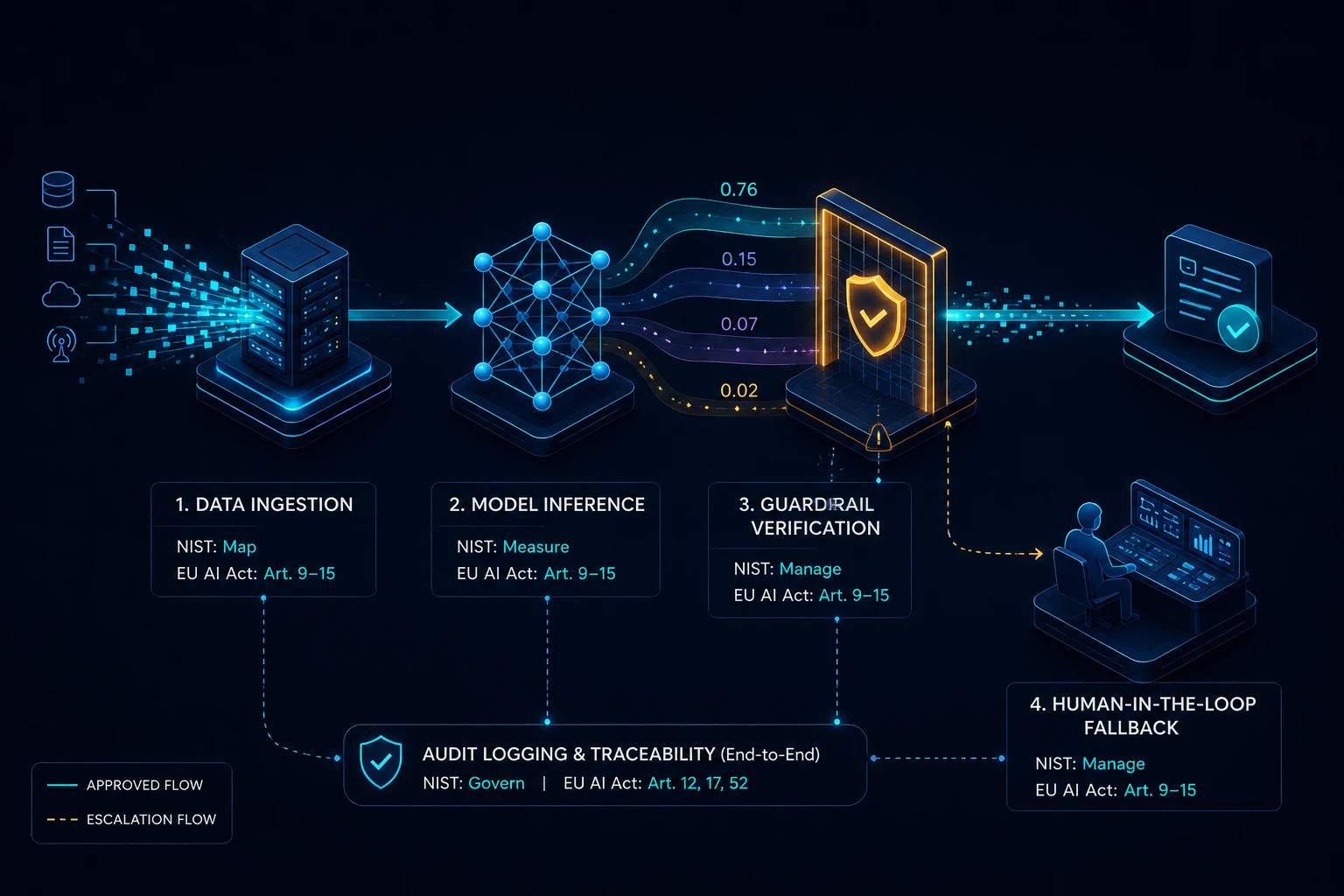
NIST AI RMF 1.0, published in January 2023, organizes AI risk management into four functions: an overarching Govern function that sets organizational policy and accountability, feeding three operational functions — Map, Measure, and Manage — that cycle continuously rather than running once. It's voluntary and non-certifiable, but it gives cross-functional teams a shared vocabulary for AI model explainability, risk, and control ownership.
ISO/IEC 42001:2023 is the certifiable counterpart. It lays out auditable requirements rather than suggestions, and applies uniformly across AI techniques — classic machine learning, rule-based systems, generative models, or autonomous agents — regardless of company size or sector. It follows the same Annex SL structure as ISO 27001, so organizations pursuing ISO 42001 enterprise integration alongside an existing information-security certification reuse a meaningful share of that infrastructure rather than starting from zero.
Why Legacy DevOps Frameworks Fail Non-Deterministic Systems
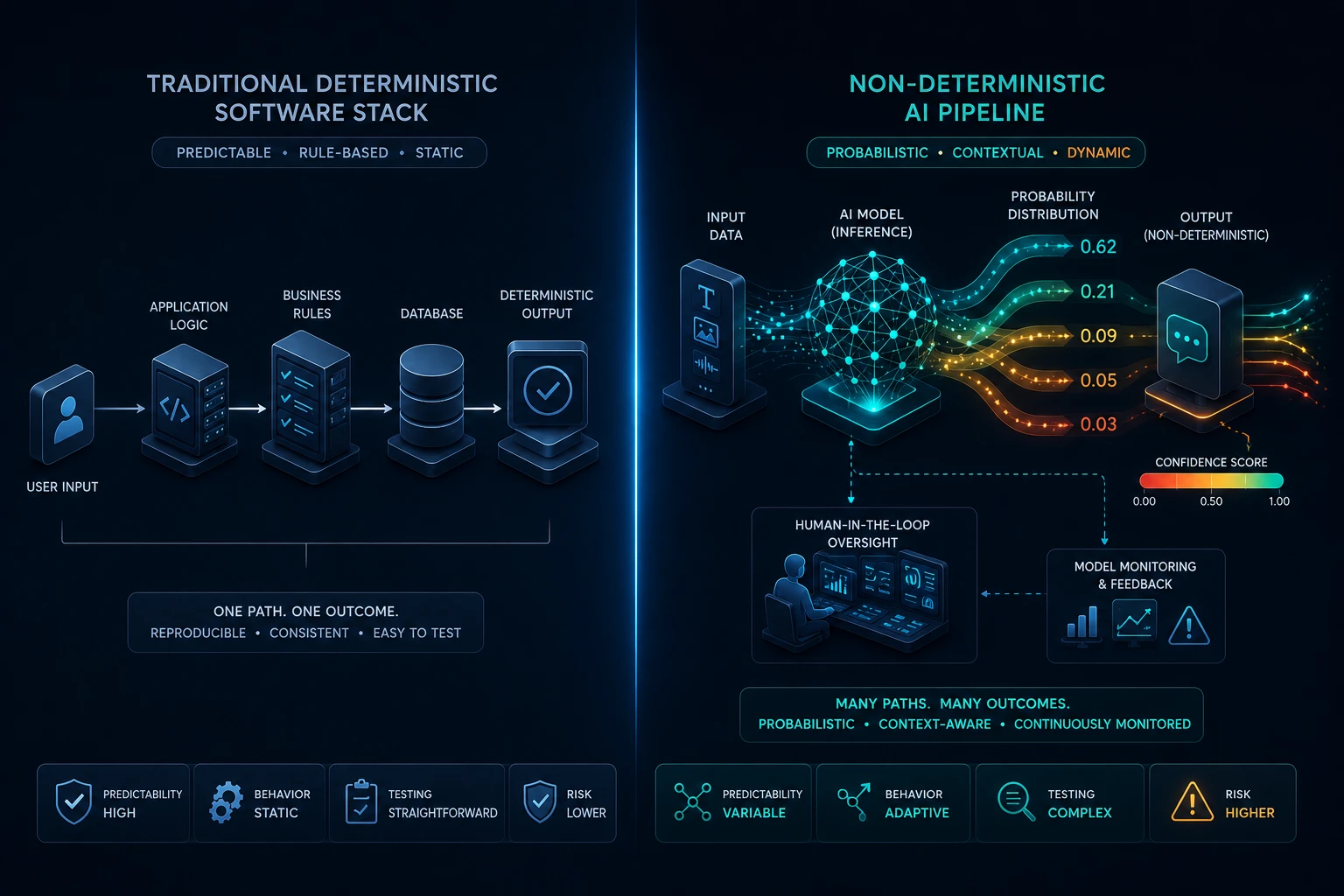
Traditional Application Performance Monitoring (APM) tooling was built for deterministic code: identical input produces identical output, or something is broken. AI systems don't work that way. The same prompt against the same model can return different outputs depending on temperature settings, context-window contents, or a silent upstream model update.
That creates blind spots standard tooling was never designed to catch:
No fixed baseline for "normal." APM alerts on deviation from an expected state. Non-deterministic systems don't have one stable expected state to deviate from.
Confidence isn't logged by default. Conventional logs capture that a function executed; they rarely capture how certain the model was about its own output.
Drift is invisible until it's a headline. A model can degrade gradually over months of dataset drift with no error thrown, no alert fired, and no ticket ever opened.
The result is shadow AI — unsanctioned tool use spreading faster than governance can track it. A 2026 survey of 1,250 office professionals at large enterprises found that roughly two in three respondents had knowingly used AI tools they believed were against company policy.
Separately, research from SHRM covering nearly 6,000 U.S. workers found that fewer than half of organizations that had adopted AI had put policies in place to govern its use. Visibility, not prohibition, is the real fix — and visibility is an engineering problem before it's a policy one.
The 5 Engineering Pillars of an Enterprise AI Governance Framework
An audit-ready AI architecture rests on five pillars. None of them are regulation-specific — build these correctly and the same infrastructure satisfies the EU AI Act, ISO 42001, and whatever any given US state ships next, simultaneously.
Pillar 1: Data Lineage & Provenance Tracking
Every dataset feeding a production model needs a documented origin, license, and hygiene record. This is also where the AI Bill of Materials (AIBOM) earns its keep: a structured, machine-readable inventory of every model, dataset, dependency, and fine-tuning pass behind a system, extending the software bill of materials (SBOM) concept security teams already maintain. One industry analysis found that barely one in five organizations can fully account for where and how AI is actually running across their own development environment — precisely the gap an AIBOM is built to close.
Pillar 2: Immutable Execution Logging
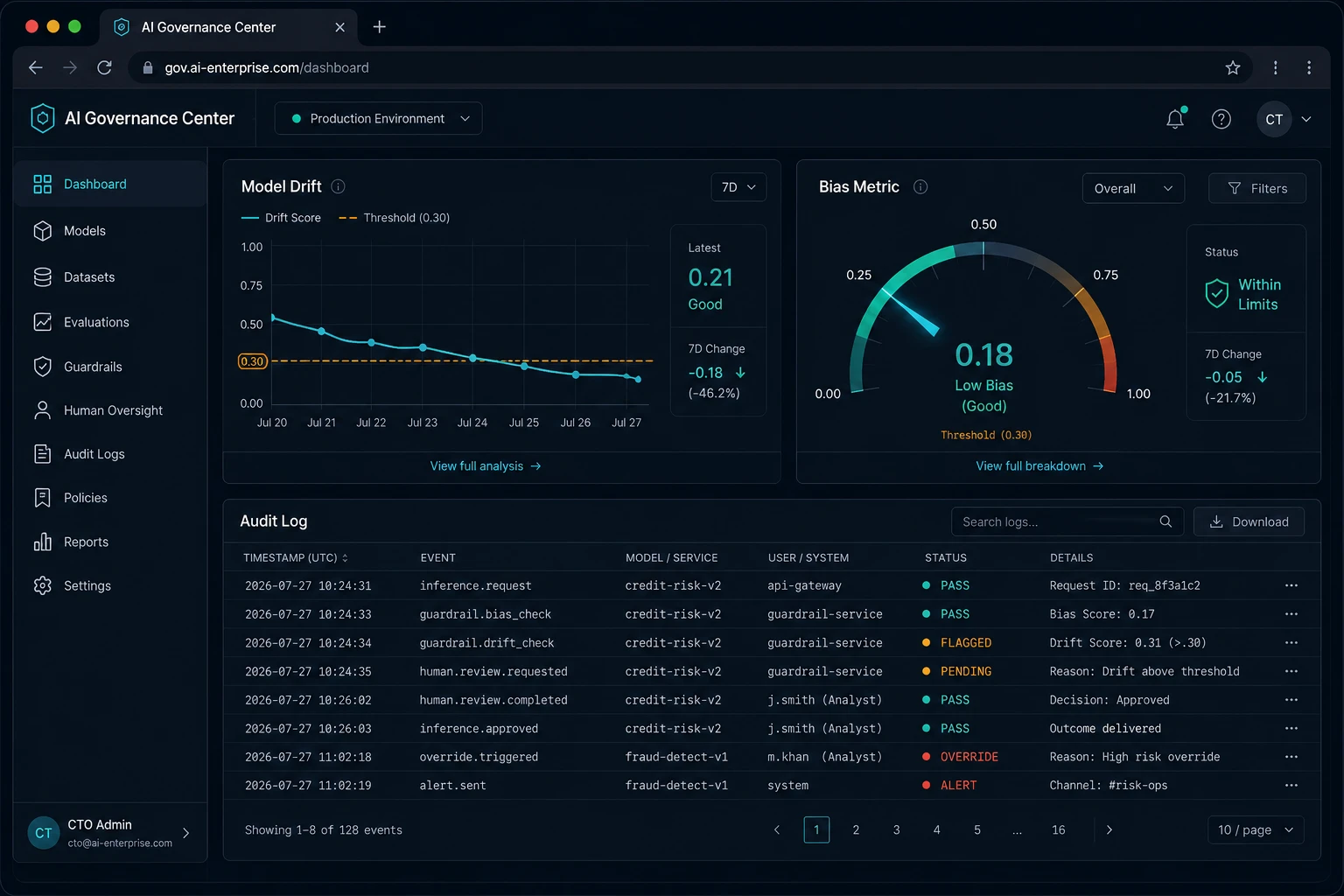
Store prompts, full context windows, model parameters, and raw outputs in append-only, tamper-evident logs. "We can reconstruct exactly what happened" is the baseline expectation of any audit, and it's also what makes after-the-fact model explainability possible at all — without immutable logs, neither is achievable.
Pillar 3: Real-Time Guardrails & Deterministic Fallbacks
Enforce PII filtering, toxicity screening, and confidence thresholds before output reaches a user or downstream system. When confidence drops below threshold, the system should fail over to a fixed, pre-approved response — not a best guess. For retrieval-augmented systems specifically, this extends to RAG-level access controls (the retrieval layer only surfaces documents a given user or agent is actually authorized to see) and sharded vector storage auditing (recording which shard of a distributed vector store served which query, so a retrieval decision can be reconstructed after the fact rather than just the final generated answer).
Pillar 4: Human-in-the-Loop (HITL) Intervention Gateways
Define exactly which decisions require human sign-off, who holds override authority, and how that override gets logged. This is the specific mechanism regulators mean when they reference a "human oversight" requirement — it needs to be a real, tested workflow, not a checkbox in a policy document.
Pillar 5: Continuous Model Drift & Bias Telemetry
Production baselines decay. Automated, continuous evaluation telemetry should track output distributions and fairness metrics against a fixed baseline on an ongoing basis, not just at initial deployment — this is where algorithmic discrimination mitigation stops being a one-time launch review and becomes an operating discipline.
Case Study: Retrofitting an Autonomous Agent Workflow for Audit Compliance
Consider a composite scenario, drawn from patterns common across mid-market financial SaaS platforms in 2026 — not a single named client, but a realistic blend of the problems we see repeatedly.
A loan-underwriting product had grown from a single support chatbot into a multi-agent pipeline: one agent pulled applicant data, a second scored risk against a retrieval-augmented policy knowledge base, a third drafted a decision summary for a human underwriter. It worked well — until the compliance team asked a simple question: if a regulator asked why applicant #4,412 was declined, could engineering answer within a business day?
At first, the honest answer was no. The fix didn't require rebuilding the pipeline — it required retrofitting the five pillars above onto the architecture that already existed:
Every agent call was wrapped in immutable execution logging, capturing full input context and raw model output, plus which vector-store shard the retrieval agent had queried.
The risk-scoring agent was modified to emit a confidence score alongside every decision, not just the decision itself.
A human override log was added at the underwriter sign-off step, capturing not only the final decision but whether and why it diverged from the model's recommendation.
The result: a mock audit that would previously have taken weeks of manual log reconstruction dropped to a matter of hours, with no meaningful latency added to the underwriting workflow itself. As enterprise architectures shift from single-prompt chatbots to complex autonomous workflows — a shift we cover in detail in our guide on how agentic AI workflows are transforming enterprise efficiency — automated audit trails stop being optional and become part of the architecture itself.
Frequently Asked Questions
What is an AI Bill of Materials (AIBOM) and why do enterprise systems need one in 2026?
An AIBOM is a structured, machine-readable inventory of every component in an AI system — models, training datasets, dependencies, licensing terms, and fine-tuning history. It functions like an ingredient label for an AI system: when a vulnerability or licensing issue turns up in a widely used base model, an AIBOM lets a security team pinpoint every affected production system immediately, instead of tracking it down manually. It also maps closely onto the technical-documentation requirements that support EU AI Act 2026 technical compliance.
How does ISO 42001 differ from SOC 2 Type II for AI-first SaaS platforms?
SOC 2 audits general SaaS security posture — access controls, data handling, availability — but the framework predates widespread AI adoption and carries no AI-specific criteria. ISO 42001 is purpose-built for AI: a certifiable standard specifically addressing AI risk management, transparency, and bias mitigation, built on the same management-system structure as ISO 27001. Most enterprise AI vendors end up pursuing both — SOC 2 because procurement teams require it as a baseline, ISO 42001 because it's the one that actually answers "how do you govern your AI."
How can software engineering teams test AI models for algorithmic bias prior to deployment?
Test against a fixed, representative baseline dataset before every production release, measuring outcome parity across protected classes rather than relying on aggregate accuracy alone. Red-team the model with adversarial and edge-case inputs designed specifically to surface disparate impact. Treat this as a release gate — the same way a security scan blocks a deployment — rather than an annual compliance exercise disconnected from the CI/CD pipeline.
What technical mechanisms support the human override requirement in high-risk AI applications?
A real HITL gateway needs three parts: a defined decision threshold that automatically routes low-confidence or high-stakes outputs to a human; an override interface that lets a human accept, reject, or modify the AI's recommendation without needing engineering support; and an immutable log capturing the override itself — who acted, and why. Without all three, "human oversight" is a line in a policy document, not an engineering control.
Strategic Implementation Roadmap & Conclusion
Regulatory deadlines will keep moving — this article alone had to be revised around a rule change that landed three days before publication. The engineering discipline behind a durable enterprise AI governance framework doesn't have to move with it. Three steps get most organizations from exposed to audit-ready:
Audit current models against the five pillars above and flag every gap in logging, lineage, or human oversight.
Update CI/CD pipelines so bias testing and guardrail verification are release gates, not after-the-fact reviews.
Establish a governance body — even a lightweight one — with clear ownership of AI risk decisions before a regulator or customer asks who owns it.
Architecting audit-ready infrastructure means aligning technical execution with regulatory mandates that don't sit still. Learn how our strategic IT consulting team helps enterprise tech leaders evaluate their stack and build AI governance infrastructure that holds up under whichever framework — EU, US, or ISO — applies to their business next.