
The Era of Agentic AI: From Chatbots to Autonomous Enterprise Agents

 By Admin
 March 30, 2026
Artificial intelligence is moving fast, and businesses are starting to notice a major shift. For the past few years, most people have associated AI with chatbots, writing assistants, and tools that can answer questions in seconds. That was the first big wave. Now, a new wave is here: Agentic AI.
This is where AI stops being just something that talks and starts becoming something that acts.
In simple terms, traditional generative AI is great at creating content, answering prompts, and supporting human work. Agentic AI goes a step further. It can make decisions, follow instructions across multiple steps, use tools, complete workflows, and even collaborate with other AI systems to finish tasks with minimal human involvement.
That is why many experts see 2026 as a turning point. Businesses are no longer asking, “Can AI write an email?” They are asking, “Can AI manage the process from start to finish?”
Welcome to the era of autonomous enterprise agents.
Generative AI vs Agentic AI: Chatting vs Doing
To understand why Agentic AI matters, it helps to compare it with the AI tools most people already know.
Generative AI is designed to produce content. It can write blog posts, summarize reports, answer customer questions, generate code snippets, or create marketing copy. It reacts to prompts and gives useful output. In most cases, however, it still depends on a human to guide the next step.
For example, if you ask a generative AI chatbot to write a customer support reply, it can do that well. But the human still has to copy the message, send it, log the ticket, update the CRM, and track the follow-up.
Agentic AI, on the other hand, is built for action. It can take a goal such as “resolve this support issue” and break it into steps. It can retrieve account data, check policy documents, draft a reply, update records, escalate if needed, and close the loop. Instead of just helping with one piece of the task, it can handle the entire workflow.
That is the real difference:
Generative AI = chatting
Agentic AI = doing
This shift is huge for enterprises because real business value does not come only from generating text. It comes from completing work. And work usually involves multiple tools, multiple steps, and multiple decisions.
Why Businesses Are Moving Beyond Chatbots
Chatbots were an important starting point. They helped companies improve support, automate basic responses, and reduce repetitive communication. But chatbots also have limits.
A chatbot can answer a question like, “Where is my order?” Yet in many businesses, it cannot verify shipping data, update the ticketing system, notify the warehouse, or create a refund request without human support.
That gap is exactly where Agentic AI enters.
Companies want AI that can move from passive assistance to active execution. They want systems that do not just provide information but also complete tasks across departments. This is especially valuable in areas where teams lose time on repetitive, rule-based workflows.
These agents are not replacing strategy, creativity, or leadership. What they are replacing is operational drag.
And for growing businesses, operational drag is expensive.
Autonomous Workflows: Where Agentic AI Creates Real Business Value
One of the biggest advantages of Agentic AI is its ability to run autonomous workflows. These are structured processes that normally require human coordination, switching between software tools, and manual follow-ups.
Let’s look at a few areas where this is already becoming powerful.
1. Customer Support
Traditional support teams spend a lot of time on repetitive tickets: password resets, order updates, refund requests, account verification, delivery questions, subscription changes, and common troubleshooting.
An autonomous support agent can:
Read the customer request
Identify intent
Verify user data
Check order or subscription details
Generate a response
Update the support platform
Trigger the next action, such as refund processing or escalation
This reduces response time and allows human agents to focus on more sensitive or complex cases.
2. Procurement
Procurement involves many small but important steps. Teams need to compare vendors, verify inventory needs, raise purchase requests, route approvals, and log records for finance or compliance.
An AI procurement agent can:
Monitor stock levels
Detect reorder points
Collect vendor pricing through APIs or web sources
Generate purchase requests
Route them for approval
Update procurement records automatically
Instead of staff spending hours checking spreadsheets and emailing suppliers, the AI can prepare everything in advance.
3. Scheduling
Scheduling sounds simple until it becomes an enterprise problem. Meetings, resource bookings, interviews, maintenance tasks, client calls, and team calendars all compete for time.
A scheduling agent can:
Check availability across calendars
Suggest suitable slots
Send invites
Reschedule conflicts
Book meeting rooms or virtual links
Notify participants automatically
In many organizations, this alone can save dozens of hours every month.
Tool Use: AI That Works Like a Digital Employee
One of the most exciting aspects of Agentic AI is tool use.
A strong enterprise agent is not limited to conversation. It can interact with the same digital systems a human employee uses every day. That means AI can move beyond generating ideas and start executing tasks in real environments.
For example, an agent may be able to:
Call APIs to retrieve or update data
Browse the web to gather current information
Read internal knowledge bases
Edit spreadsheets and documents
Create reports
Trigger workflows in ERP, CRM, or HR systems
Send emails or notifications
Analyze files and summarize findings
This is what makes Agentic AI feel less like a chatbot and more like a digital team member.
Imagine a finance assistant agent that receives an instruction like, “Prepare a weekly purchasing summary.” Instead of simply describing how to do it, the agent can fetch procurement data through an API, collect invoice records, update a spreadsheet, generate a summary, and email the final report to management.
That is not just intelligent conversation. That is operational execution.
In enterprise environments, this matters because business work is spread across tools. No single app holds everything. People jump between dashboards, inboxes, documents, tickets, and databases. Agentic AI brings those disconnected systems together into one task-driven process.
Multi-Agent Systems: When AI Agents Work as a Team
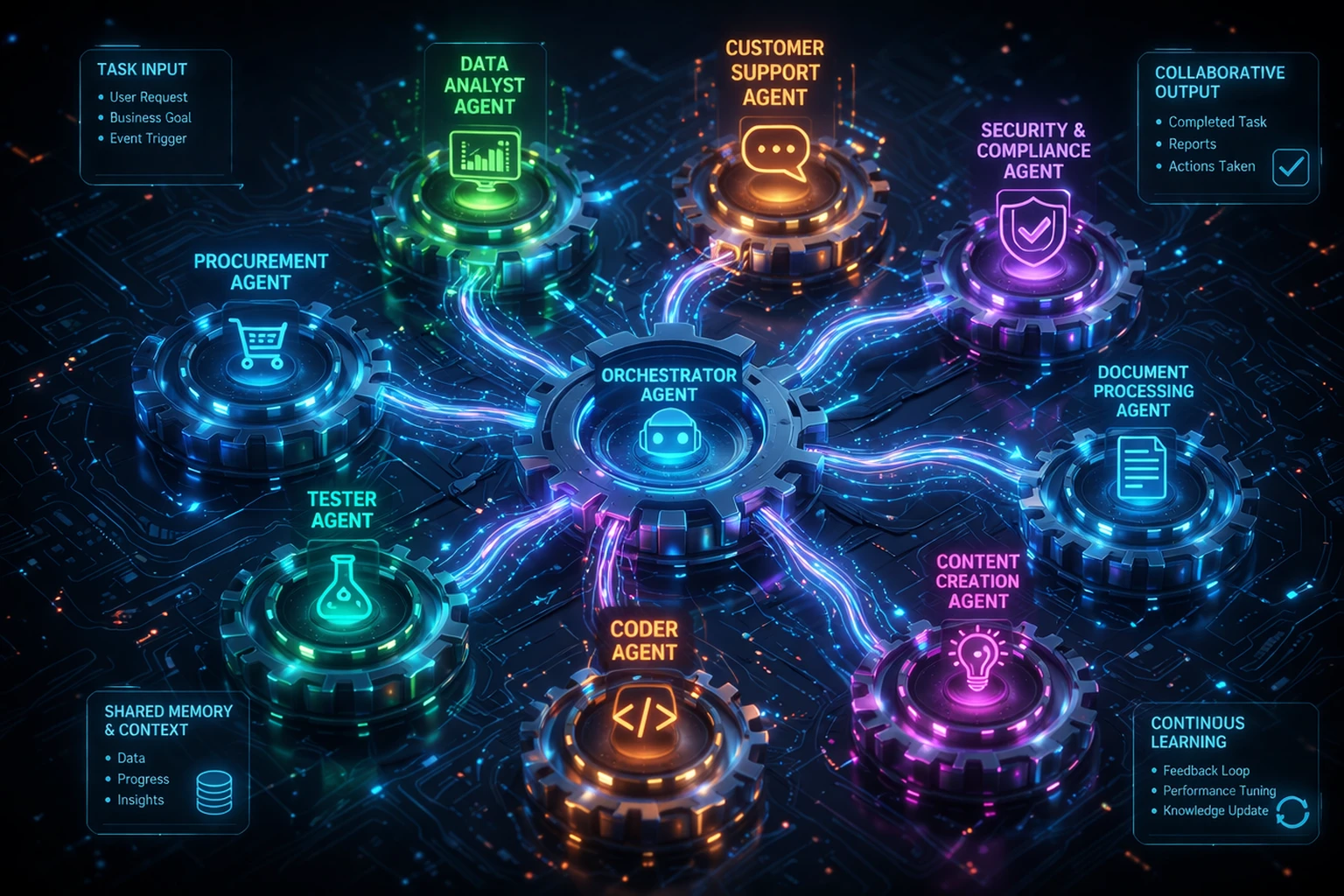
As business operations become more complex, one AI agent may not be enough. This is where multi-agent systems come in.
A multi-agent system includes several specialized agents, each responsible for a specific role. Instead of building one giant AI that does everything, organizations can deploy focused agents that collaborate like a team.
Here is a simple example in software development:
A Coder Agent writes and updates code
A Tester Agent checks functionality and finds issues
A Reviewer Agent validates quality and standards
A Documentation Agent creates technical summaries and release notes
Together, these agents can move work from concept to execution much faster than a single tool working alone.
The same idea can apply across business functions:
A support agent handles tickets
A compliance agent checks policy alignment
A reporting agent builds executive dashboards
A scheduling agent manages internal coordination
Each agent has a clear responsibility, but they share context and work toward the same business goal.
This model is especially useful for enterprises because companies already operate through specialized teams. Multi-agent systems reflect the natural structure of the workplace. They allow businesses to build AI ecosystems instead of isolated automation tools.
Why Agentic AI Is a Big Deal for Enterprises
Enterprises do not just need speed. They need consistency, visibility, scalability, and control.
That is why Agentic AI is gaining serious attention. It can help companies standardize workflows, reduce manual effort, improve response times, and create better operational traceability.
Here are some of the biggest benefits:
Faster Execution
Tasks that once took hours can be completed in minutes. This helps teams move faster without increasing headcount for every repetitive process.
Lower Operational Load
Employees spend less time on admin-heavy work and more time on problem-solving, customer relationships, and strategic priorities.
Better Process Consistency
AI agents can follow defined workflows in the same way every time, reducing human error and making operations more reliable.
24/7 Availability
Unlike human teams, agents can keep workflows moving after office hours. This is especially valuable for global businesses and customer-facing operations.
Easier Scalability
As businesses grow, operations become more complex. Agentic AI helps scale execution without creating the same level of process bottlenecks.
Challenges Businesses Should Not Ignore
Of course, Agentic AI is not magic. It needs structure, governance, and careful implementation.
Businesses adopting AI agents should think seriously about:
Data privacy
Access control
Workflow boundaries
Human approval points
Audit trails
Quality assurance
Exception handling
Not every task should be fully autonomous on day one. In many cases, the smartest approach is to start with human-in-the-loop systems where AI agents execute most of the work but humans approve critical decisions.
The goal is not reckless automation. The goal is trustworthy automation.
Enterprises that succeed with Agentic AI will be the ones that combine innovation with governance.
The Rise of the Digital Workforce
By the end of 2026, many businesses will no longer think about AI as just a tool. They will think about it as a digital workforce.
This does not mean replacing entire teams overnight. It means building a new layer of operational capacity. Human employees will still lead strategy, relationships, creativity, and decision-making. But AI agents will increasingly handle execution-heavy tasks in the background.
Think of it this way:
Humans define goals
Agents carry out workflows
Systems report results
Leaders focus on growth
That model is incredibly attractive for businesses under pressure to do more with less.
Companies that adopt this early will likely gain advantages in speed, cost efficiency, service quality, and scalability. Companies that ignore it may find themselves stuck with slower processes while competitors build leaner and smarter operations.
Final Thoughts
The era of AI is no longer just about content generation. It is about action.
Generative AI introduced businesses to the power of machine intelligence. Agentic AI is showing what happens when that intelligence is connected to workflows, tools, and business goals.
From customer support and procurement to scheduling and software delivery, autonomous enterprise agents are changing how work gets done. Add tool use and multi-agent collaboration into the mix, and the future becomes much bigger than chatbots.
The businesses that win in the next phase of AI will not be the ones that only use AI to write faster. They will be the ones that use AI to operate smarter.
By the end of 2026, every serious company will be thinking about its digital workforce strategy.
The question is no longer whether Agentic AI is coming.
The real question is whether your business will be ready for it.