
AI-Native Development: The Future of High-Speed Software Engineering

 By Admin
 March 30, 2026
AI-Native Development: The Future of High-Speed Software Engineering
Software development is changing fast. Not long ago, engineering teams were judged by how quickly they could write code, ship features, and patch bugs in aging systems. Today, the conversation is shifting. The smartest teams are no longer asking, “How do we code faster?” They are asking, “How do we build, modernize, deploy, and maintain software with AI woven into the entire engineering lifecycle?” That is the heart of AI-native development.
AI-native development is not just about using an assistant to autocomplete a function or suggest a query. It is about rethinking software engineering from the ground up. In this new model, AI helps architects sketch system designs, supports developers in modernizing legacy platforms, assists platform teams in managing infrastructure, and takes repetitive documentation and testing work off engineers’ shoulders. This shift is not theoretical either. Google Cloud’s 2025 DORA report says AI adoption in software development has surged, and AI is increasingly being used as part of core workflows rather than as an occasional helper.
For companies like Preesoft, this is a powerful topic because it reflects where software delivery is heading. Businesses no longer want slow, fragmented, legacy-heavy development. They want modern platforms, cleaner architectures, faster releases, and engineering teams that can move with confidence. AI-native development is becoming the bridge between legacy complexity and high-speed software engineering.
Assisted Architects: AI Is Designing Systems, Not Just Writing Snippets
One of the biggest myths about AI in engineering is that it only helps with code generation. In reality, its role is growing far beyond writing snippets. Modern AI tools are now being used to support architecture planning, system decomposition, service mapping, API design, and infrastructure decisions. Instead of starting from a blank page, architects can work with AI to generate possible system layouts, identify dependencies, and compare different design patterns.
This matters because architecture is where speed is often won or lost. A weak architecture creates technical debt, delays, and rework. A strong one creates clarity for the whole team. AI gives software architects a faster way to evaluate choices before implementation begins. It can help outline microservice boundaries, suggest database design patterns, generate event-driven workflows, and even flag missing security or observability considerations based on known best practices. Microsoft’s guidance for production AI systems also emphasizes that modern AI solutions must be designed with lifecycle management, security, and distributed system complexity in mind, which reinforces the value of architecture-level thinking from day one.
For engineering-led firms, this changes the game. Instead of spending days in scattered whiteboard sessions, teams can move from concept to structured design much faster. Human judgment still matters most, but AI becomes a multiplier. It helps teams explore more options, spot blind spots earlier, and create stronger technical foundations.
Legacy Modernization: Turning Old Systems into Modern Products
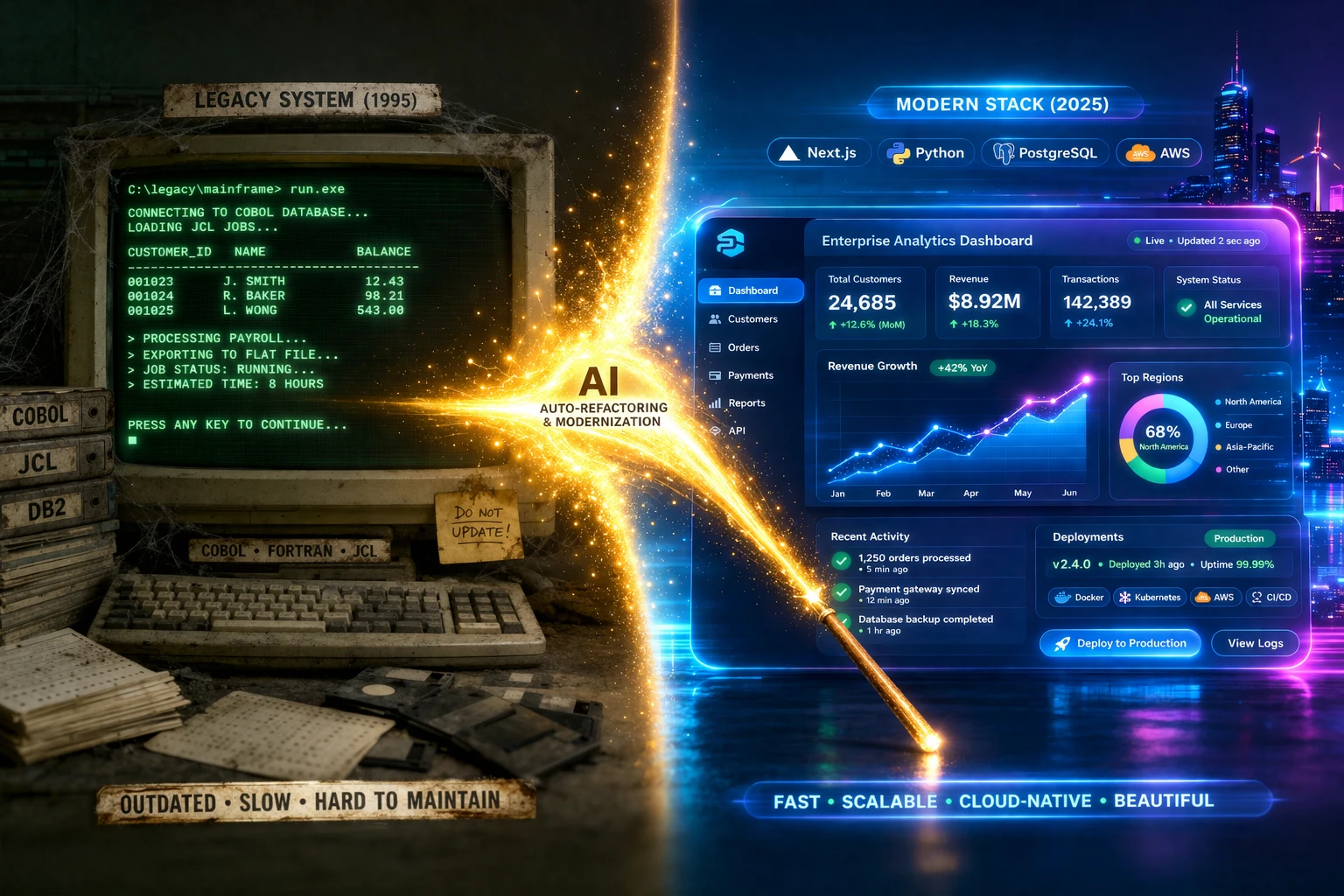
Legacy software is one of the biggest barriers to innovation. Many enterprises are still running critical workflows on older stacks such as Java monoliths, mainframes, or COBOL-based systems. These systems may still work, but they are expensive to maintain, difficult to scale, and slow to evolve. For years, modernization projects were feared because they were costly, risky, and time-consuming. AI is starting to change that.
AWS now offers dedicated modernization capabilities through AWS Transform, including AI-assisted conversion of legacy code into modern languages while preserving functional equivalence. AWS also documents code transformation with generative AI as a way to accelerate modernization several times faster than traditional approaches. This is important because it shows that legacy modernization is no longer just manual rewrite work. AI can analyze old systems, understand business logic, suggest mappings, and support refactoring into cleaner modern architectures.
Imagine a business running a legacy backend that was built years ago for internal use. With AI-native modernization, engineers can map existing workflows, extract business rules, refactor modules, and move toward modern frameworks like Next.js for frontend experiences and Python or cloud-native services for backend intelligence. The process still needs expert review, testing, and validation, but the amount of manual effort drops significantly.
For companies serving clients across SaaS, enterprise platforms, and custom software, this is a huge opportunity. Clients do not always need a full rebuild from scratch. Sometimes they need a smarter path forward. AI makes that path faster and more realistic.
Platform Engineering: AI Meets Cloud Infrastructure
Modern software is not just about application code. It is also about the platform underneath it: cloud resources, deployment pipelines, observability layers, networking, security policies, and infrastructure as code. This is why platform engineering has become such an important discipline. Teams want self-service infrastructure, repeatable deployments, and automated governance instead of manual cloud setup.
AI is now helping here as well. Azure’s documentation on Infrastructure as Code highlights how infrastructure can be provisioned and managed consistently through code, while Microsoft also positions Azure and GitHub together for platform engineering with self-service capabilities, DevOps automation, and security best practices. In practical terms, AI can help teams write and validate IaC templates, troubleshoot failed deployments, suggest policy changes, summarize cloud configurations, and improve operational visibility.
This is especially useful for growing engineering companies. Cloud platforms like AWS and Azure are powerful, but they can quickly become overwhelming when environments multiply and teams scale. AI can reduce friction by helping engineers understand configuration drift, optimize deployment workflows, and automate repetitive platform tasks. Instead of spending hours checking YAML, Terraform, Bicep, or container configurations manually, teams can use AI to accelerate routine platform work and focus more on reliability and architecture.
The long-term benefit is not just faster deployment. It is stronger engineering consistency. AI-native platform engineering supports standardization, reduces avoidable human error, and helps teams build environments that are easier to manage over time.
DevEx: Better Developer Experience, Less Burnout
Developer Experience, often called DevEx, is becoming one of the most underrated drivers of engineering performance. When developers are buried in repetitive testing, ticket updates, release notes, documentation, and small maintenance tasks, productivity suffers. More importantly, energy suffers. Engineers lose time on low-value work and have less space for problem-solving, design, and innovation.
This is where AI can create immediate value. The 2025 Stack Overflow Developer Survey found that around 69% of AI agent users agreed AI agents increased productivity, and about 70% agreed they reduced the time spent on specific development tasks. The same survey also found strong agreement that AI helps automate repetitive work. Those findings match what many teams are seeing in practice: AI is at its best when it removes friction.
Think about the daily reality of a developer. There are unit tests to write, regression cases to update, endpoint documentation to clean up, pull requests to summarize, logs to analyze, and repetitive bug reproduction steps to document. None of this is unimportant, but not all of it requires deep human creativity. AI can take the first pass on many of these tasks. It can generate test cases, draft technical documentation, explain legacy functions, summarize diffs, and help onboard developers into unfamiliar codebases.
This makes engineering healthier as well as faster. Burnout is not only caused by hard work. It is often caused by constant task-switching, repetitive overhead, and lack of flow. AI-native teams are improving DevEx by giving developers more room to focus on meaningful engineering instead of endless grunt work.
The 10x Engineer Is Becoming the 10x Team
For years, the tech industry loved the idea of the “10x engineer.” It usually described a rare individual who could outperform others through skill, speed, and judgment. AI-native development is changing that idea. The future is less about one heroic engineer and more about AI-first teams that work with better leverage.
GitHub has previously reported productivity gains of up to 55% with AI coding tools, while Google’s DORA research shows that AI adoption has expanded sharply and that its impact is tied to broader organizational systems, not just the tools themselves. That distinction matters. AI does not magically turn weak engineering practices into strong ones. But when high-performing teams adopt AI with good architecture, review processes, security habits, and delivery discipline, the speed gains can be significant.
This is why many AI-first teams are delivering products much faster than traditional teams. They move faster in planning, coding, testing, documenting, deploying, and iterating. They use AI as a force multiplier across the pipeline. Instead of adding more people to solve every delivery problem, they improve the system around the people they already have.
For firms like Preesoft, that is the real message. AI-native development is not about replacing engineers. It is about building engineering systems where talented teams can operate with more speed, confidence, and consistency.
Why AI-Native Development Matters Now
The future of software engineering will belong to teams that can combine human expertise with intelligent automation. Legacy-heavy delivery models are becoming too slow for modern business demands. Clients want scalable architectures, faster modernization, stronger cloud operations, and smoother product delivery. AI-native development answers that need.
It helps architects think bigger. It gives legacy systems a practical path to modernization. It supports platform engineering with more automation. It improves developer experience by reducing repetitive work. And it turns engineering productivity into a team-level advantage rather than a one-person miracle.
The shift from legacy to AI-driven engineering is already underway. The companies that embrace it early will not just build software faster. They will build better systems, make smarter technical decisions, and create stronger delivery engines for the future. That is what makes AI-native development more than a trend. It is quickly becoming the new standard for high-speed software engineering.